2026 World Cup Draw Unveiled: Inside the Pots System That Will Shape Football's Biggest Tournament
The 2026 World Cup is rapidly approaching.
Christmas is nearly here (hard to believe, right?), and soon we'll be entering 2026—which means we're only months away from the biggest World Cup ever held, taking place across the United States, Canada and Mexico, beginning on June 11.
However, even before the New Year begins, we'll experience our first glimpse of World Cup excitement with the official draw. This is when we'll discover which teams will face each other in the group stage, and get an early preview of how the elimination rounds might develop.
With the coming tournament including 48 teams rather than the usual 32, you may be asking: How will the draw process actually work?
No need to worry. We've explained everything for you.
How Will the 2026 World Cup Draw Function?
There were original proposals for the 48 teams to be organized into 16 groups of three, but FIFA eventually decided to maintain a more traditional format for 2026: 12 groups of four.
For the draw process, the 48 teams will be separated into four pots of 12.
Pot 1 includes the three host nations—the USMNT, Canada and Mexico—along with the nine top-ranked qualified countries according to the November 2025 FIFA Men's World Ranking. Pots 2, 3 and 4 will be populated by the remaining qualified teams in ranking sequence, with Pot 2 containing the strongest of that collection and Pot 4 the lowest-ranked.
Not all 48 teams are confirmed at the time of the draw—only 42 have secured qualification—with the remaining six spots to be determined in March 2026 playoffs. Those unconfirmed teams are still allocated to Pot 4, regardless of their ranking position.
From this point, the 12 groups are created by selecting one team from each pot—though, as typical with FIFA draws, there are restrictions.
Teams from the same confederation cannot be grouped together, except for UEFA nations, where groups must include at least one and no more than two. The three co-hosts are also fixed into specific groups for logistical and travel purposes: Mexico in Group A, Canada in Group B and the USMNT in Group D.
FIFA has introduced another element "for competitive balance purposes." The top four non-host countries in the rankings will be distributed across opposing brackets: Spain and Argentina on one side, France and England on the other. If all four advance as group winners, they cannot meet until the semifinals—and those on opposite sides wouldn't clash until the final.
Finish second or third though, and that organized separation vanishes instantly.
After a team is selected, it goes into the first available group alphabetically, with the draw system ensuring all restrictions are followed. And unlike past tournaments, where teams were drawn directly into their group slot, this time all top-seeded teams (Pot 1) automatically take position one, with a preset grid later determining how the other teams fit into the schedule.
Complicated, we understand, but in the most basic terms: Four pots of 12, one team from each pot in every group—with hosts predetermined, confederations kept apart and the world's elite teams strategically distributed.
Confirmed Pots for the 2026 World Cup Draw
Here are the verified pots for the 2026 World Cup draw—including each team's seed and current FIFA World Ranking.
Pot 1 | Pot 2 | Pot 3 | Pot 4 |
|---|---|---|---|
1. USA (14) | 13. Croatia (10) | 25. Norway (29) | 37. Jordan (66) |
2. Mexico (15) | 14. Morocco (11) | 26. Panama (30) | 38. Cape Verde (68) |
3. Canada (27) | 15. Colombia (13) | 27. Egypt (34) | 39. Ghana (72) |
4. Spain (1) | 16. Uruguay (16) | 28. Algeria (35) | 40. Curaçao (82) |
5. Argentina (2) | 17. Switzerland (17) | 29. Scotland (36) | 41. Haiti (84) |
6. France (3) | 18. Japan (18) | 30. Paraguay (39) | 42. New Zealand (86) |
7. England (4) | 19. Senegal (19) | 31. Tunisia (40) | 43. UEFA Play-Offs Path A Winner |
8. Brazil (5) | 20. Iran (20) | 32. Ivory Coast (42) | 44. UEFA Play-Offs Path B Winner |
9. Portugal (6) | 21. South Korea (22) | 33. Uzbekistan (50) | 45. UEFA Play-Offs Path C Winner |
10. Netherlands (7) | 22. Ecuador (23) | 34. Qatar (51) | 46. UEFA Play-Offs Path D Winner |
11. Belgium (8) | 23. Austria (24) | 35. Saudi Arabia (60) | 47. IC Play-Off 1 Winner |
12. Germany (9) | 24. Australia (26) | 36. South Africa (61) | 48. IC Play-Off 2 Winner |
How are the Final Qualifiers for the 2026 World Cup Decided?

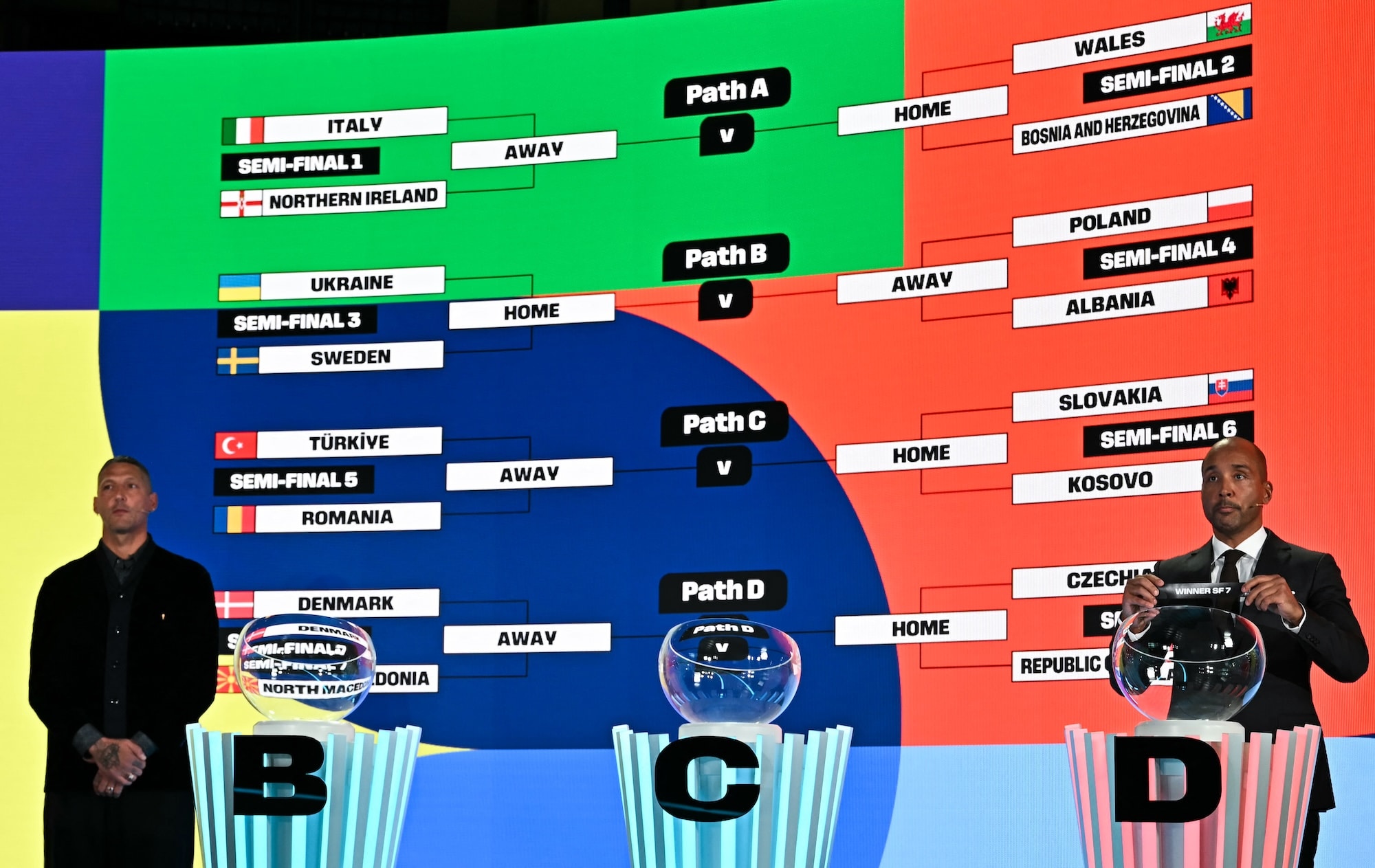
The remaining six positions for the 2026 World Cup will be settled through two distinct routes: The UEFA playoffs and the intercontinental playoffs.
The UEFA route provides four spots and includes 16 teams: The 12 second-place finishers from the European Qualifiers group stage, plus four teams that advanced through the 2024–25 UEFA Nations League. These teams will compete in eight semifinals and four finals, with the final winners securing World Cup qualification.
The UEFA playoff semifinals are arranged as follows:
Meanwhile, the intercontinental playoffs will determine the last two World Cup positions, with six teams competing in two separate routes.
The two top-ranked sides, DR Congo and Iraq, are seeded and automatically advance to each route's final. The other four teams compete in semifinals—New Caledonia vs. Jamaica and Bolivia vs. Suriname—with the winners progressing to face the seeded teams.
The champions of each final will secure the final two spots at the 2026 World Cup.
When is the 2026 World Cup Draw?
The group-stage draw for the 2026 World Cup is set for Friday, December 5, and will take place at the John F. Kennedy Center in Washington, D.C.
It begins at 12 p.m. ET (that's 9 a.m. PT / 5 p.m. GMT). Both President Donald Trump and FIFA President Gianni Infantino will attend the event.
READ THE LATEST WORLD CUP NEWS, PREVIEWS & ANALYSIS HERE