
Arne Slot vs Jurgen Klopp: The Shocking Truth After 100 Liverpool Games
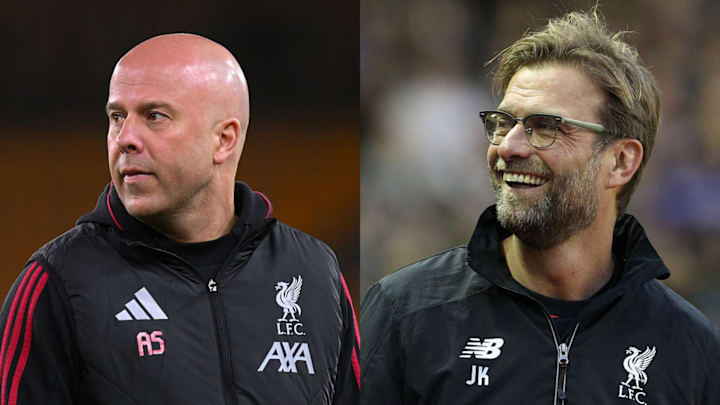
Arne Slot reached his landmark 100th game as Liverpool's head coach on Tuesday evening, though a loss to Galatasaray wasn't how he envisioned celebrating this achievement.
Liverpool succumbed to an early strike in Istanbul from former Southampton and Fulham player Mario Lemina. This marks the second occasion the Reds have suffered defeat against Galatasaray in this Champions League campaign, leaving them with work to complete in the return fixture at Anfield.
Slot enjoyed a perfect beginning at Liverpool after replacing modern Anfield icon Jürgen Klopp during summer 2024, taking over the German's squad and promptly securing just a second championship since 1990 to match Manchester United's historic English league title tally.
Difficulties emerged following a summer rebuild, investing a record-breaking $599 million (£446 million) during one transfer period on acquisitions who have largely failed to deliver consistent performances, alongside declining form from previous season's standout players—notably Mohamed Salah and Virgil van Dijk.
This means at his century milestone, Slot has secured 62 victories, recorded 15 stalemates and suffered 23 defeats. Worryingly, 13 of those losses have occurred in the current campaign alone, with over two months remaining. However, remarkably, his overall career success rate stands only slightly better at 62.3%.
The reality is that Slot's statistics compared to Klopp at the identical point of the German's Liverpool tenure are considerably superior. During Klopp's opening 100 fixtures, spanning from his October 2015 arrival through August 2017, he managed only 50 victories. There were 21 losses, slightly fewer than Slot's tally, and 29 draws.
Klopp's Liverpool during their first 100 matches maintained a marginally stronger defensive record, though Slot's team has found the net more frequently.
Jürgen Klopp, Arne Slot: First 100 Liverpool Matches
Jürgen Klopp, Arne Slot: First 100 Liverpool Matches
Statistic | Jürgen Klopp | Arne Slot |
|---|---|---|
Wins | 50 | 62 |
Draws | 29 | 15 |
Losses | 21 | 23 |
Goals For | 182 | 208 |
Goals Against | 108 | 118 |
Naturally, Klopp inherited a vastly different scenario at Liverpool in October 2015, with the club securing sixth position in the final complete season prior to his appointment.
Under Brendan Rodgers' guidance, the Reds had nearly captured the Premier League crown in 2013–14. However, it became clear the squad was dependent on Luis Suárez, whose 2014 transfer to Barcelona triggered a swift decline. Liverpool's transfer strategy wasn't yet refined, and the funds from the brilliant Uruguayan's sale were largely squandered.
After assuming control 12 matches into 2015–16, Klopp achieved an eighth-place Premier League conclusion, followed by an enhanced fourth-place finish in 2016–17. Only in the subsequent season, after exceeding 100 games in command, did Klopp possess a squad beginning to match Liverpool's standards and compete for major trophies.
Arne Slot: 'I've Been Lucky'
Arne Slot: 'I've Been Lucky'

Prior to the Galatasaray encounter, Slot candidly admitted that his Liverpool situation was extremely favorable, inheriting a prepared squad.
"I've been fortunate to receive an excellent team last season and this season," he commented. "I have complete confidence that these players will deliver at the standards expected of a Liverpool squad."
Slot also justified his performance, arguing his tenure is being unfairly criticized.
"I don't believe I have a poor record, though sometimes you sense otherwise when hearing all the commentary!" he emphasized.
The most recent Liverpool manager who failed to reach 100 games was Sir Kenny Dalglish, who oversaw 74 during his second tenure from January 2011 to May 2012—he was initially meant to be temporary and had previously managed 307 matches from 1985–1991.
Nearly all Liverpool managers receive extended opportunities. Klopp ultimately handled 491 matches despite his gradual beginning, while Roy Hodgson's 31-game period remains an unusual exception rather than standard practice.