
 ไทย
ไทย English
 中國人
中國人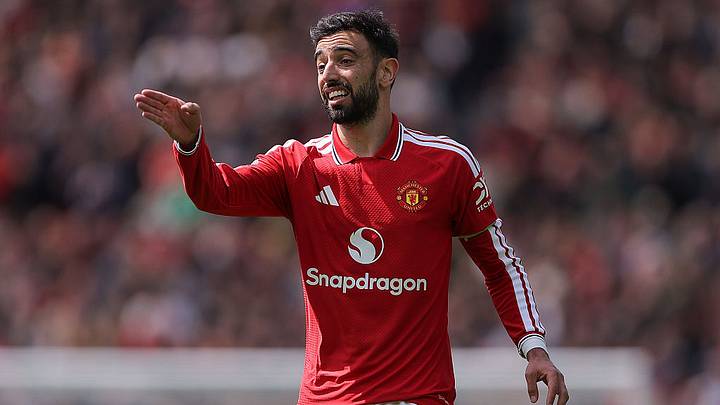
Manchester United skipper Bruno Fernandes has revealed he attempted to contact Roy Keane directly in a bid to address criticism from the former Old Trafford captain that has veered into what he describes as "lying."
Fernandes enjoyed a remarkable 2025–26 campaign, both collectively and individually. He guided a revitalized United back into the top tier of the Premier League and secured Champions League football, while also collecting numerous personal honors at club and league level—among them the Sir Matt Busby Player of the Year award for a record fifth time, and the Premier League Player of the Season.
Beyond his accolades, Fernandes also etched his name into Premier League history by recording 21 assists, surpassing the single-season record that had stood for 23 years and had only been matched once prior to this campaign.
It was precisely that achievement which sparked Keane's latest outburst. After Fernandes equaled the record—at that point jointly held by Thierry Henry and Kevin De Bruyne—during United's final home fixture against Nottingham Forest, Keane took umbrage with comments he misread as the Portuguese midfielder placing personal milestones above team success.
Following the record-equaling moment, Fernandes said: "There were probably moments today when I should have passed instead of shot. I'm very happy for the assist, but more than that, I'm happy for the win and to finish the season on a high."
Then, appearing on The Overlap's Stick to Football podcast, Keane incorrectly interpreted those words as Fernandes chasing personal statistics. "How can your mindset of a footballer be going into a match to be about an individual record? He won't be winning trophies, not with that mindset of the team."
Now, as a guest on The Diary of a CEO podcast, Fernandes seized the chance to respond, accusing Keane of spreading a "lie" and "putting words in my mouth."
"I don't like when people lie about things, and this case you said about Roy Keane. Basically, what he said is a lie because either he saw some other interview or he can't say that I said one thing that I've just not said. Luckily for me is everything on record," the player told host Steven Bartlett.
"I accept his criticism, I accept that he might like me as a player or not, like me as a person or not. But what I don't like is that he puts words in my mouth that have not been said. That's the only thing I don't like."
Fernandes revealed he had asked former United boss Ole Gunnar Solskjær—Keane's teammate from 1996 to 2005 and a close friend—to connect him with the Irishman. Given the timing, it remained unclear whether he had obtained a contact number before the interview was filmed.
In what appeared to be a veiled response, Keane seemingly fired back via an Instagram post that read, "Too much attention makes a donkey think he's a lion."
Reaction, Attitude to Criticism Important

The manner in which Fernandes addressed criticism is exactly what you'd expect from a Manchester United captain. It is one of the most scrutinized roles in world football, and absorbing criticism from every direction—particularly during an era that has lacked the club's former glories—is an unavoidable part of wearing the armband.
By and large, Fernandes embraces it and will "always take criticism from everyone and anyone," without retaliating—the Keane episode being an exception solely because of the perceived "lie" being told.
"[Keane] can criticize me, killing me, say that I'm not good enough, that I'm not a good captain for him, that I'm not a good player for the club whatsoever," Fernandes explained. "It's bad, it's O.K., I don't mind, it is his opinion. Do I like it? No, obviously I prefer Roy Keane to give me some praise sometimes because I've achieved something that not many players have achieved."
It seems Fernandes is capable of letting the vast majority of negativity slide without allowing it to affect his mindset. The mental side of sport is enormous, and permitting self-doubt to take hold is already half the battle lost.
Pursuit of Glory > Money

This season could have unfolded very differently for Fernandes. A lucrative offer from Saudi Arabia was on the table last summer, and the club appeared willing to let him make his own decision. Al Hilal were the interested party, reportedly dangling an annual wage of close to $50 million.
Even for a player earning a substantial Premier League salary, that figure is almost incomprehensible. Yet Fernandes chose to put his sporting ambitions first.
"I said it before, I haven't fulfilled my dreams here at [Manchester United]," came the reply when asked why he turned down the Saudi offer.
United have not won the Premier League—or come close to doing so—since 2013 and, within the next couple of seasons, have aspirations of bringing 'Project 150' to fruition. Fernandes, now believed to be in contract extension discussions, will be central to those ambitions.
His wife also backed the decision to remain in Manchester.
"The words she said were like, 'Have you achieved everything you wanted to achieve in your career and is this the next step you want to take for your future and for your career?'" Fernandes recalled of that conversation.
"Obviously, [the Premier League] is the league I want to be in. This is the best league in the world, this is where I'm going to enjoy my football as I'm not going to enjoy it in any other place so we still have dreams to fulfill."
Risk/Reward Balance Explains Fernandes Assists
Fernandes shattering the Premier League single-season assist record was a natural outcome of how inventive his play had been throughout the year. Logically, a more creative player will accumulate more assists based on sheer volume and probability.
Fernandes created 136 chances across his 35 Premier League appearances. The next closest was Liverpool's Dominik Szoboszlai with 78.
He doesn't always play it safe, but he plays with a readiness to attempt the kind of bold moves that generate opportunities. Retaining possession at all costs is not his priority.
"I think it's always risk-reward," he said. "You need to understand how much reward you're going to get from that and if taking that risk is good for the team or not. The position I play, you need that.
"It has to be one of your main skills, to take risks, to do things that the game demands from you and to make sure that your teammates in the front get the ball in the positions that is going to be the [higher] rate of success for them to score a goal. I might miss two or three times but if I get one right that can become a goal for us and I think there's nothing better than a risk-reward that is a goal."