
 ไทย
ไทย English
 中國人
中國人
While nothing has been confirmed yet, all signs point to Bruno Guimarães drawing ever closer to a move to Arsenal.
The Gunners are reported to have had two offers turned down by Newcastle United but remain intent on securing the Brazilian, with reports indicating they are now prepared to pay approximately $107.5 million (£80 million). Having initially probed Newcastle with lower bids, Arsenal are now said to be growing increasingly optimistic about striking a deal.
Guimarães is also thought to be keen on the switch to North London and, tellingly, has been absent from Newcastle's squad for their preseason training camp in Spain—only fueling speculation that a transfer is on the horizon.
Should the move be completed, Mikel Arteta would be bringing in one of the Premier League's most well-rounded midfielders. Equally capable as a defensive midfielder, a creative force or, most naturally, a box-to-box dynamo, Guimarães provides the tactical versatility to operate across multiple positions.
With that in mind, here are two ways Arsenal could set up with Guimarães in the team.
Guimaraes Alongside Rice
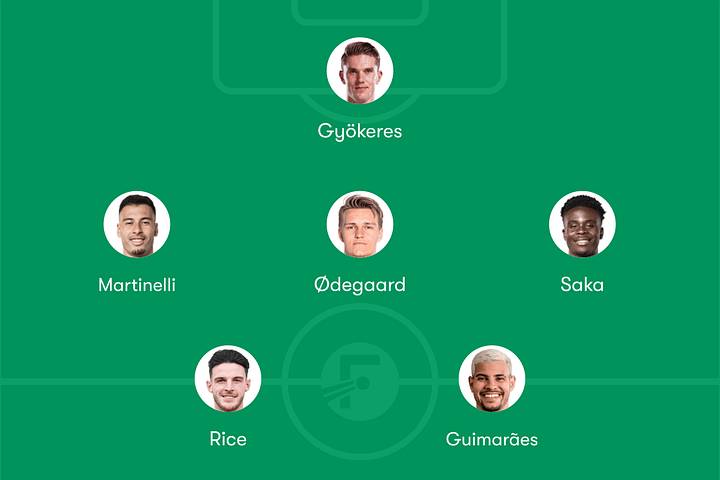
Arsenal relied heavily on a 4-2-3-1 formation throughout their 2025–26 Premier League title-winning campaign, deploying two holding midfielders—typically Declan Rice and Martín Zubimendi—behind a classic No. 10, supported by two wide players and a single striker up front.
Rice is virtually impossible to leave out when available, meaning if Bruno Guimarães is to fit into Mikel Arteta's favored system, it would most likely be Zubimendi who loses his spot—despite an impressive first season at the Emirates.
On paper, the change makes sense. Guimarães spent much of last season playing in a midfield pairing alongside Sandro Tonali at Newcastle, but with the license to advance up the pitch, influence the attack and arrive in the penalty area, wrapping up the campaign with nine Premier League goals and six assists.
The challenge, however, is that Rice also enjoys driving forward, while Arteta is unlikely to want to bench Zubimendi given how pivotal he proved last season. As a result, this setup seems plausible—but perhaps not the most probable outcome.
Guimaraes, Zubimendi and Rice

As noted, Zubimendi was exceptional during his debut Arsenal campaign. Assured and composed on the ball, resistant to pressure and consistently progressive in his distribution, his deep-lying role became a key factor in why the Gunners were so adept at breaking down organized defenses.
For that reason, it is hard to picture Arteta simply dropping him from the lineup. Instead, the more probable solution could involve scrapping the traditional No. 10 role entirely.
Arteta will still look to preserve width through players like Gabriel Martinelli and Bukayo Saka, with Noni Madueke and new arrival Christos Tzolis also offering options. That could mean the biggest sacrifice is the attacking midfield slot—and consequently club captain Martin Ødegaard's place in the starting lineup.
Dropping your captain would be a bold call, but Ødegaard's influence in attack has visibly faded over the past two seasons. Last year, he managed just one goal and seven assists across 24 appearances, frequently failing to deliver the creative spark that once established him as one of the Premier League's most dangerous midfielders.
Enable functional cookies to see this feature.
By contrast, Guimarães contributed nine Premier League goals and six assists, Zubimendi chipped in with five goals and one assist, while Rice registered four goals and seven assists. Those figures suggest Arsenal would not necessarily sacrifice attacking output by replacing Ødegaard with Guimarães and transitioning to a midfield three.
Of all the possible approaches, this appears to be the path Arteta is most likely to pursue.