
 ไทย
ไทย English
 中國人
中國人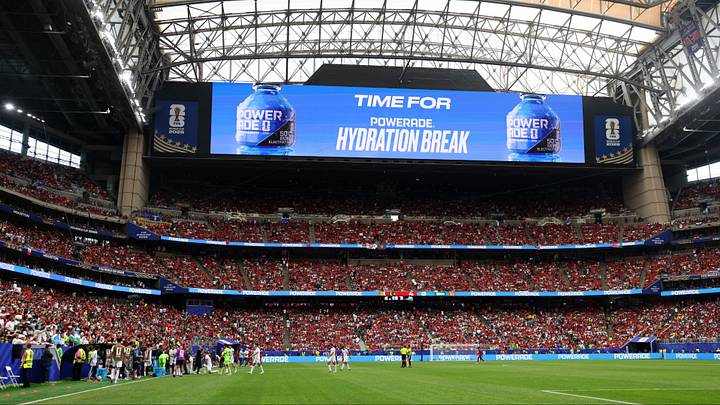
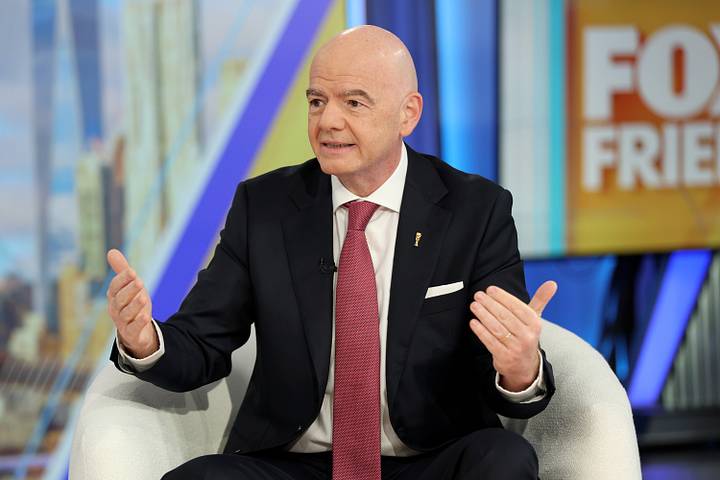
FIFA president Gianni Infantino has firmly stated that FIFA gains "absolutely nothing" from hydration breaks, as he moved to defend the controversial new stoppages introduced at the 2026 World Cup.
Prior to this summer's tournament, it was announced that compulsory three-minute breaks would occur in the middle of each half at the World Cup, intended to allow players to rehydrate amid the highly unpredictable weather conditions across the United States, Canada and Mexico.
While the general concept of a hydration break has rarely drawn complaints—having been used occasionally since 2014 for games played in extreme heat—FIFA's choice to enforce a stoppage in every half regardless of weather conditions has sparked widespread backlash from fans, with many accusing the governing body of simply manufacturing additional airtime for broadcast partners to air commercials.
Boos have echoed throughout stadiums across all three host nations this summer as those in the stands reflect the frustration of many watching from home on television.
"There is no additional revenue for FIFA, as all commercial agreements were signed well in advance," Infantino said in a statement. "So, this is not a financial issue for us. For us, it is purely a sporting matter."
He went on to say: "The primary reason is the heat, but we also need to recognize that in a competition like the World Cup, played over 39 days, with teams potentially playing eight matches during that span, having a moment to recover is critically important.
"What matters even more to us is ensuring that all teams, in every match, are competing under the same conditions. It's very hard to accept that a coach might be able to influence a game by making tactical adjustments simply because it's hotter, while in another match, where temperatures are slightly cooler, that same coach doesn't have the same opportunity.
"We want to guarantee equal conditions for all, and that is precisely why these breaks are applied in every match.
"Right up until the final seconds, players are still attacking and pushing forward. And perhaps—perhaps not—but perhaps it's also due to this brief rest that players are able to return to the pitch and truly show what they're capable of."
Will Hydration Breaks Continue Beyond the 2026 World Cup?
The concept of a hydration break, on its own, will remain a fixture in soccer—and rightly so. The stoppage was introduced 12 years ago amid concerns that soaring temperatures at the 2014 World Cup in Brazil could pose serious health risks to players.
Since then, hydration breaks have been applied on a situational basis around the world. Once a specific temperature threshold is reached, a stoppage becomes mandatory. If conditions remain below that level, each 45-minute half is played without interruption.
SI answers is our AI answer engine trained on human-created content.
UEFA, European soccer's governing body, has already confirmed it has no intention of departing from that approach, with mandatory hydration breaks in the Champions League or at the 2028 European Championships not currently on the agenda.
Decision-makers in other regions of the world will face pressure to adopt similar positions, while FIFA will also be pushed to make a ruling ahead of the 2030 World Cup, co-hosted by Morocco, Portugal and Spain and featuring standalone matches in Argentina, Paraguay and Uruguay as part of celebrations marking the competition's 100th anniversary.