
 ไทย
ไทย English
 中國人
中國人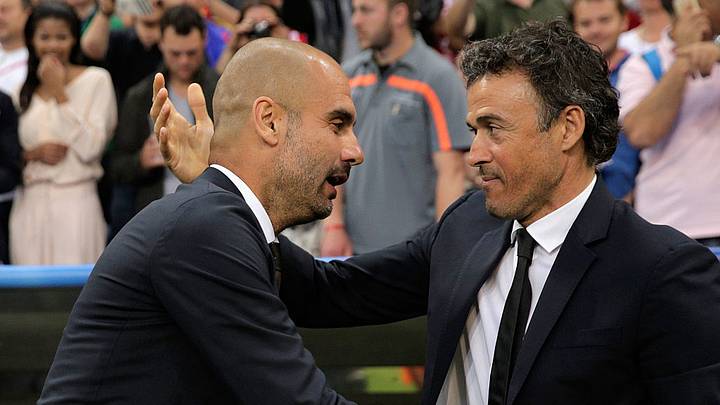
Some are calling it the impossible task. How can Enzo Maresca possibly succeed a decade of Pep Guardiola-led supremacy in Manchester?
Yet history shows that greatness can be inherited, channeled and expanded upon. From Liverpool's legendary 'Boot Room' dynasty to Arne Slot's Premier League title triumph in a post-Jürgen Klopp era, there are plenty of local precedents to inspire Manchester City's new manager.
Looking further back, Stefan Kovacs claimed two European Cups with Ajax following Rinus Michels's totaalvoetbal revolution, while Fabio Capello refined Arrigo Sacchi's two-time European Cup-winning side into serial Serie A champions and the conquerors of Johan Cruyff's Barcelona Dream Team in 1994.
Those who have successfully stepped into the shoes of a preceding genius typically share a prior working relationship and benefit from a largely unchanged core squad. Maresca has inherited a Man City side that has seen considerable turnover over the last two years, with several Guardiola-era stalwarts having departed.
This marks a new chapter at the Etihad Stadium, with a former Guardiola assistant at the helm. Here's a look at how the Spaniard's successors at his previous three clubs have performed.
Luis Enrique (Barcelona Atlètic)

Barcelona 'B', rebranded as Barcelona Atlètic in 2008, boasts quite the managerial pedigree. It was, naturally, where Guardiola began his journey to transform soccer, and he was immediately succeeded by a future three-time Champions League-winning coach, Luis Enrique.
Enrique is among just 17 players to have featured on both sides of the Clásico rivalry, and one of the very few to move directly between Barça and Real Madrid. After five years in the Spanish capital, Enrique wrapped up his playing days with an eight-year stint in Catalonia.
Upon being named Guardiola's successor in 2008, Enrique declared: "I have come home."
Two years earlier, Enrique had volunteered to manage newly promoted top-flight side Gimnàstic de Tarragona for free, with plans to bring Guardiola on board as his assistant. The club's board rejected the offer, and Nàstic subsequently spent the next 19 seasons outside La Liga — a true sliding-doors moment.
Guardiola instead returned to Barça and guided the reserve side up to the third tier. Enrique built on those foundations, steering the team to promotion to the Segunda in his second season and reaching the Segunda playoffs — which they were ineligible to contest — in 2010–11, accumulating an impressive 71 points.
Sergi Roberto, Marc Bartra and Thiago Alcántara were among the standout performers under Enrique before he departed for Roma in 2011.
Tito Vilanova (Barcelona)

While the weight of Guardiola's legacy hadn't loomed too heavily over Enrique in a relatively low-stakes role, it had certainly cast a long shadow by the time Tito Vilanova was appointed Barcelona manager in 2012.
Guardiola had helped construct what many consider the greatest club side in soccer history. Barça collected 14 major trophies during his four-year tenure, including two Champions Leagues and three La Liga titles. Yet he was worn down by José Mourinho's psychological battles by the close of the 2011–12 season, with Real Madrid's devastating counter-attacking style bringing Barça's era of dominance to an end.
Los Blancos appeared set for their own extended period at the top, as Barça turned to Guardiola's trusted lieutenant Vilanova in an attempt to reassert themselves.
The handover proved seamless. Vilanova won 23 of his opening 25 La Liga matches, and Barça led the table from the first matchday to the last, equalling Madrid's record tally of 100 points from the previous campaign.
Tragically, Vilanova's tenure was cut short by illness, and he passed away at just 45 years old in 2014. The club's post-Guardiola decline only truly set in under the stewardship of managers like Ronald Koeman and Quique Setién.
Carlo Ancelotti (Bayern Munich)

Guardiola played a significant role in reshaping German football, though Bayern Munich's revival had actually begun before the Spaniard's arrival. Louis van Gaal is widely credited with dragging the storied German club into the modern era, and 'gegenpressing' became the dominant philosophy after Bayern defeated Bundesliga rivals Borussia Dortmund in the 2013 Champions League final.
Guardiola faced an enormous challenge when he arrived in an unfamiliar setting following the success delivered by Jupp Heynckes, who had secured three straight league titles and two DFB-Pokals. Three consecutive Champions League semifinal exits, however, meant the Spaniard left with a lingering sense of unfinished business.
Hungry for another European triumph, Bayern turned to the most decorated manager in the competition's history. Carlo Ancelotti is far from an ideological mirror image of Guardiola, but the club believed the Italian possessed the wisdom to fine-tune rather than dismantle what had been built not only by the Spaniard, but also by the likes of Van Gaal and Heynckes.
Enable functional cookies to see this feature.
Nevertheless, Ancelotti's spell in Munich proved somewhat underwhelming. Domestic dominance continued, but the team regressed in Europe, falling to Real Madrid in the Champions League quarterfinals.
Key players grew frustrated with the Italian early in his second season, with the influential Thomas Müller publicly stating he felt undervalued by the manager. A squad packed with stars struggled to adapt to Ancelotti's relaxed approach, which stood in stark contrast to Guardiola's meticulous attention to detail.
Matters reached a breaking point in September 2017, when Ancelotti was dismissed following a 3–0 loss to Paris Saint-Germain.