
 ไทย
ไทย English
 中國人
中國人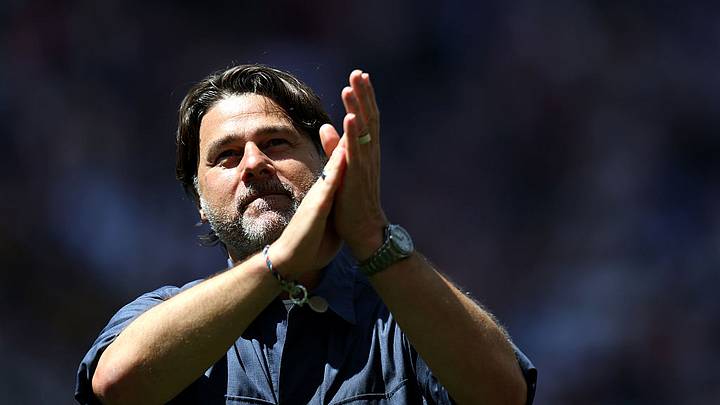
The U.S. men's national team is already etching its name in the history books this summer, largely thanks to the vision and leadership of head coach Mauricio Pochettino.
The Stars and Stripes kicked off their 2026 World Cup campaign in emphatic fashion, routing Paraguay 4–1 in a spectacular atmosphere at SoFi Stadium. They then backed that up with a commanding 2–0 victory over Australia on Friday. It marked the first time since 1930 that the USMNT secured two wins in the group stage — and the first time ever in the modern World Cup era. In that original 13-team tournament, the Americans defeated Belgium and Paraguay in back-to-back matches to reach the semifinals, where they were ultimately crushed by Argentina 6–1.
The only other occasion the U.S. claimed two World Cup victories across all rounds came in 2002, when they stunned Portugal 3–2 in their group stage opener before scraping through to the knockout rounds via a draw and a loss. The Americans then beat Mexico 2–0 in the round of 16 to reach the quarterfinals — the deepest run the team has ever made in the modern tournament era.
Pochettino, in just two World Cup matches, has already equaled the record for most World Cup wins by any USMNT head coach, drawing level with Bruce Arena (2002) and Robert Millar (1930), with plenty more history still within reach.
The Murphy, Argentina-born manager took charge of the USMNT in September 2024, stepping into his first international role as the country prepared to host the 2026 World Cup. Here are three key reasons why Pochettino is the ideal man to guide the Stars and Stripes toward World Cup glory this summer.
Pochettino's Resumé

Pochettino ranks among the most respected coaches in world football, boasting a track record that includes spells at Premier League clubs Tottenham Hotspur (2014–19) and Chelsea (2023–24), as well as Ligue 1 giants Paris Saint-Germain (2021–22).
He has worked with some of the sport's all-time greats, including Lionel Messi, Kylian Mbappé, and Neymar — all of whom featured for PSG during his time in charge.
His appointment was seen as a major statement of intent for the USMNT, part of a growing trend of top national teams turning to elite foreign managers rather than relying on homegrown coaches with federation ties. Brazil has five-time Champions League-winning Italian manager Carlo Ancelotti (AC Milan, Real Madrid) at the helm, while England is led by German tactician Thomas Tuchel, who claimed the Champions League and FIFA Club World Cup with Chelsea in 2020–21 and the Bundesliga title with Bayern Munich in 2022–23.
Pochettino's Thoroughness, Tactical Ingenuity

Since assuming the role, Pochettino has been remarkably thorough in testing both formations and personnel, determined to explore every option in his search for the ideal World Cup squad.
He evaluated more than 80 players across a wide range of systems — including variations of three-back and four-back setups — in the buildup to the tournament, before finalizing his 26-man roster late last month.
The constant experimentation drew criticism along the way, as the U.S. delivered underwhelming results in competitive fixtures, finishing fourth in the 2024–25 Concacaf Nations League and falling short in the 2025 Concacaf Gold Cup. The heavy rotation also made it difficult for the team to establish a clear identity.
Yet the long-term investment has paid off handsomely, with the squad now operating with precision and displaying a level of quality rarely seen from a U.S. side on the world's biggest stage. A strong identity has also taken shape — one built on front-foot aggression and passion, underpinned by disciplined team structure. That character was on full display in the USMNT's pre-tournament friendlies earlier this month against Senegal and Germany, both impressive showings against top-tier opposition.
"As you saw against Germany, the aggression, the fight, Pochettino brings that South American spirit that we've been missing," USMNT veteran winger Timothy Weah said following the 2–1 friendly defeat to Germany. "We've always been the good guys, so it's nice being on the other end and being the aggressor a bit. Coach Poch is an amazing coach, and I can't wait to see what we do under him."

Pochettino truly demonstrated his tactical acumen against Australia, as the Socceroos attempted to unsettle the U.S. with a deliberate game plan. Rather than competing for possession, Australia sat deep with five defenders and four midfielders, inviting the Americans to dominate the ball while looking to exploit the predictability of their lateral passing game.
The Argentine responded shrewdly by shifting to a three-back system, trusting his center backs to cover for one another against swift counterattacks while freeing the rest of the team — particularly the wingbacks — to push forward aggressively. He also deployed two strikers instead of one to overload Australia's defensive line and maximize the team's chances of converting the limited opportunities it was afforded. The approach paid off brilliantly, with the U.S. scoring twice from just two shots on target.
"He's always given us different ideas to attack," star striker Folarin Balogun said of Pochettino after the match. "To play with [striker Ricardo Pepi] today wasn't a shock...It felt like another solution to win the game. Australia played with a back-five, so two strikers occupying the center backs is also a good idea. That's credit to the boss, and you can see today that it worked."
Pochettino's Relentless Belief, American Attitude
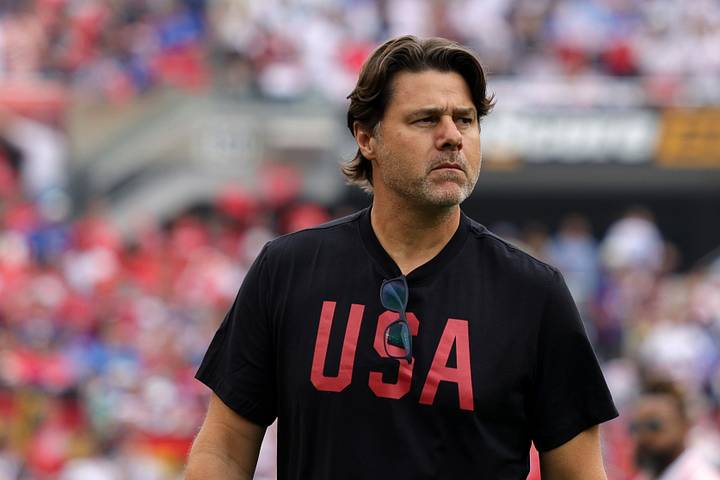
Despite being widely dismissed by the broader soccer world, Pochettino has set the bar high for the U.S.'s World Cup campaign, declaring back in February that even a quarterfinal exit would fall short of his expectations.
"We want to win [the World Cup], we are winners," Pochettino said at the time. "It's complicated for every team to win the World Cup, it won't be easy. It's also a different experience with different circumstances. We'll see, surprises can always happen.
"It's true that nobody in the world puts the USMNT among the favorites to win the World Cup, I'm conscious of that. But internally, when we took on the challenge of going to the World Cup, we considered: 'Why not? Why not win it? Why not make it to the final stages of the World Cup?'"
The coach has embraced a refusal to be constrained by conventional thinking when it comes to his team's ceiling, pointing to soccer's most celebrated underdog tales as proof that logic can be defied — including co-host South Korea's stunning semifinal run in 2002 and Morocco's remarkable achievement of reaching the same stage in Qatar just four years ago.
"In soccer, logic plays a limited role," he said. "There are no mathematical equations to predict the outcome. That's also why it's the most beautiful sport in the world, because it's sometimes unfair. It's about being competitive, but also about managing emotions."
"It's a good mix of logic and illogic, rationality and irrationality. Assuming we have a quality squad with a good mentality and the support of the fans, everything is in place to generate positive energy and attempt what South Korea and Morocco achieved in 2002 and 2022."
He has repeatedly championed the "Why not us?" mindset, drawing inspiration from the quintessentially American "Miracle on Ice" story. The 1980 U.S. men's hockey team pulled off one of sport's greatest upsets en route to Olympic gold — a piece of history that has captivated Pochettino. It stands as the American underdog narrative, embodying just one of many American values the foreign coach has drawn upon to motivate his players.
SI answers is our AI answer engine trained on human-created content.
"We're American, we don't take s---. That's something he really drilled into us," midfielder Sebastian Berhalter said ahead of Friday's match, reflecting on Pochettino's motivational approach. "Even though he's Argentinian, he has that mindset. This is what we do, this is who we are, and this is what America is about."
With the USMNT off to a stunning start this summer, Pochettino's grand ambitions are beginning to look far less far-fetched.