
Inside the VAR Chaos: How Controversial Calls Decided Liverpool's Wild Finale at Nottingham Forest

During an intense eight-minute period at the conclusion of Liverpool's visit to Nottingham Forest's City Ground on Sunday, Alexis Mac Allister experienced the complete spectrum of feelings that football—and VAR technology—can deliver.
The Argentine playmaker deflected Ola Aina's attempted clearance, which luckily sailed beyond Forest keeper Stefan Ortega in the 89th minute, celebrating what appeared to be an unlikely victory for Liverpool. Yet a prompt VAR examination would overturn Mac Allister's unconventional strike due to handball, leaving both the midfielder and coach Arne Slot stunned.
The entire City Ground shared that bewilderment during the seventh minute of added time when Mac Allister netted once more. Another VAR check threatened to rob Liverpool again, but the strike was eventually validated to secure a 1–0 victory.
Why Alexis Mac Allister's First Goal vs. Nottingham Forest Was Disallowed
Why Alexis Mac Allister's First Goal vs. Nottingham Forest Was Disallowed

The Premier League's official match centre X account relied on referee Anthony Taylor's field explanation to justify Mac Allister's cancelled goal.
"Following the review," Taylor announced to the City Ground spectators, "the ball contacts the arm of the scorer, Liverpool No. 10. Consequently, it's an unintentional handball by the goalscorer, resulting in a direct free kick."
Handball remains a contentious rule in contemporary football. Nevertheless, this situation is clarified by eliminating any requirement to establish intent. According to Law 12 in the FA Handbook, it constitutes a handball violation if a player "scores in the opponents' goal directly from their hand/arm, even if unintentional" or "immediately following contact with their hand/arm."
Mac Allister protested to anyone available that the ball hit the upper part of his arm—which wouldn't qualify as handball under the "T-shirt line" rule—and told Sky Sports that practical judgment should apply to the regulation.
"It struck my back and elbow. I comprehend the rule, but if you understand football, that goal should have counted," he contended. "It's disappointing in the moment, but that's how it goes. VAR is beneficial when you consider the errors referees previously made. We must accept these delays because it improves football.
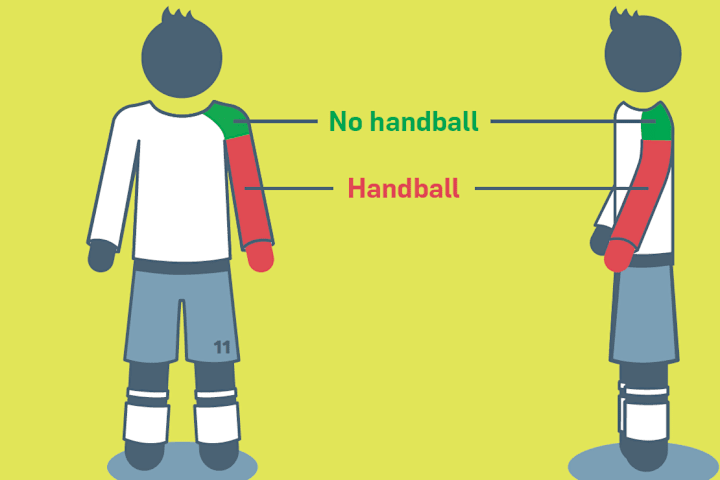
To identify which body parts an outfield player cannot use, the FA Handbook references the diagram above with this explanation: "For handball offense purposes, the arm's upper limit aligns with the armpit's lower edge."
While Mac Allister may have indicated his shoulder top during his protests, footage clearly demonstrates the ball hitting his elbow, which falls within the handball zone.
Why Alexis Mac Allister's Second Goal Was Allowed to Stand
Why Alexis Mac Allister's Second Goal Was Allowed to Stand
Remarkably, the Premier League chose not to provide official commentary on the goal that secured Liverpool's victory. This time, Mac Allister wasn't under examination—his composed close-range finish contained no controversy—but potential offside concerns surrounded two teammates.
Hugo Ekitiké was clearly ahead of the deepest Forest defender, yet his lack of ball contact meant he wasn't considered to be interfering with play. Virgil van Dijk, meanwhile, directed a header toward goal that led to Mac Allister's opportunistic finish.
An assessment using the Premier League's semi-automated offside system determined that Van Dijk was marginally onside relative to Ola Aina—perhaps by the width of a toenail.