
Mexico Dodges Critical Setback as They Prepare for High-Stakes Bolivia Showdown

Mexico's national squad continues its preparation for the 2026 World Cup with a Sunday visit to Bolivia, though they'll compete in a significantly more manageable setting, escaping the crushing elevation that gives Bolivia one of soccer's most formidable home advantages worldwide.
Coach Javier Aguirre sought challenging away venues for El Tri during their January training camp. Mexico began this tour by beating Panama 1–0 at Estadio Rommel Fernández, a venue where they hadn't claimed victory since 2000.
Traveling to Bolivia to face a squad gearing up for the 2026 World Cup playoffs remains challenging, though it could have been significantly tougher.
Mexico and Bolivia will clash at Estadio Ramón Tahuichi Aguilera, situated in Santa Cruz de la Sierra at 420 meters (1,378 feet) elevation. With World Cup playoffs approaching rapidly, Bolivia is scheduling matches at reduced altitudes to adapt to conditions they'll encounter at Monterrey's Estadio BBVA when facing Suriname on March 26.
Traditionally, Bolivia gained advantages by hosting matches in their capital La Paz, positioned roughly 3,660 meters (12,000 feet) above sea level. This crushing elevation helped equalize contests against South America's elite teams.
However, starting in 2024, Bolivia escalated their strategy by hosting final 2026 World Cup qualifier home matches at what's possibly soccer's most intimidating venue—a stadium Mexico will be grateful to avoid.
Bolivia's Unforgiving Fortress at Estadio Municipal de El Alto
Bolivia's Unforgiving Fortress at Estadio Municipal de El Alto
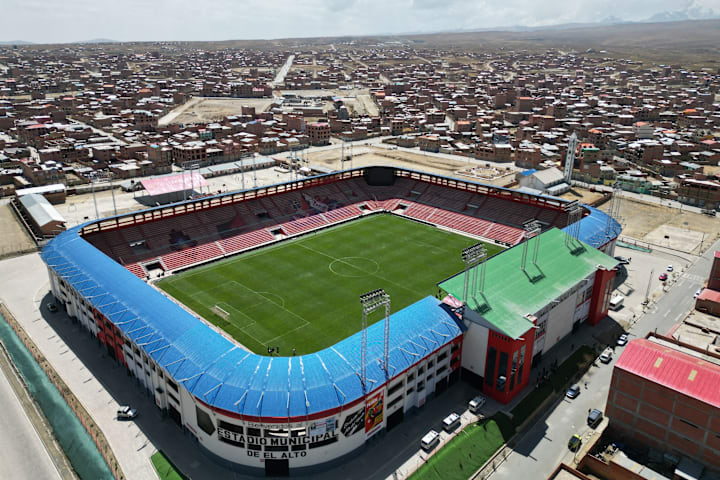
Bolivia maintains World Cup qualification hopes largely due to discovering an impenetrable stronghold at Estadio Municipal de El Alto. Positioned in El Alto city—meaning "The High"—within the Andes mountains, this venue sits approximately 4,150 meters (13,615 feet) above sea level.
La Paz's altitude hadn't particularly benefited Bolivia, who ranked second-worst after six South American 2026 World Cup qualifier matches, suffering two home defeats. Desperately needing results, Bolivia relocated to El Alto as their new base, and Óscar Villegas's team remained unbeaten at home throughout the remaining qualifiers.
FIFA had previously prohibited international matches above 2,750 meters (9,020 feet). With this restriction now removed, Bolivia went undefeated at a stadium featuring a pitch-side motto declaring "4,150 MT ALT. Se juega donde se vive" (4,150 meters altitude. We compete where we reside).
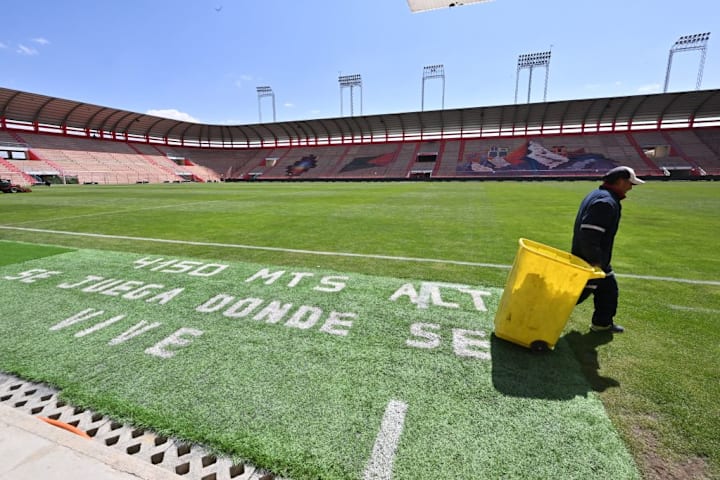
During late 2024, Bolivia crushed Venezuela 4–0 and subsequently beat Colombia 1–0—a team that had suffered just one defeat in nearly two years—in their inaugural international home matches at El Alto. Subsequent draws against Paraguay and Uruguay preceded victories over Chile and Brazil in the qualifiers' final match, securing Bolivia's World Cup playoff position.
Bolivia may be considered South America's weakest national team, yet their merciless home field advantage has created an opportunity to reach the World Cup for the first time since 1994.
Bolivia's Home and Away Record During 2026 World Cup Qualifiers
Bolivia's Home and Away Record During 2026 World Cup Qualifiers
Category | Home | Away |
|---|---|---|
Points | 17 | 3 |
Victories | 5 | 1 |
Defeats | 2 | 8 |
Ties | 2 | 0 |
Goals For | 13 | 4 |
Goals Against | 7 | 28 |
The Criticism of Bolivia's Home Field Advantage
The Criticism of Bolivia's Home Field Advantage

The brutal conditions Bolivia imposes on visiting teams at El Alto have generated substantial criticism from numerous players and coaches.
Following Brazil's September defeat at El Alto, Barcelona and Brazil star Raphinha spoke candidly: "When a team forces you to compete at 4,000 meters altitude just to secure victory, it creates a massive disadvantage for every other national squad."
Venezuela became Bolivia's first victim at their punishing home venue in September 2024. Post-match, then-coach Fernando Batista declared playing at El Alto was "inhumane."
Previously, notable players like Neymar Jr. also called high-altitude matches inhumane—despite never competing at El Alto. After a 2017 La Paz match, Neymar posted images of Brazilian players using oxygen masks while recovering from playing in Bolivia's thin air.
Former Venezuela international Alí Cañas supported Batista's comments, adding: "Medical considerations prohibit playing at such elevations—at any moment something serious could happen to a player and we'll regret it."
Bolivia cannot defend their 2026 World Cup qualification at El Alto's extreme altitude. Nevertheless, they'll likely return to their newly discovered fortress for 2030 World Cup qualifiers, where criticism will probably resurface regarding the safety of competing at one of Earth's most extreme locations.