
 ไทย
ไทย English
 中國人
中國人
VANCOUVER — Billowing clouds of blue and white smoke and a bold, straightforward design carried a powerful message through Vancouver's streets from the Whitecaps faithful.
The "Save The Caps" movement had officially begun.
One of three Canadian MLS clubs, the Whitecaps have been on the market since 2024. Despite hovering near the top of the Supporters' Shield standings and advancing to both the Concacaf Champions Cup and MLS Cup finals in 2025, their long-term future in the city remains uncertain. Relocation speculation continues to mount.
The lease agreement at BC Place runs through the end of the 2026 season—a modest extension of the prior deal that expired in 2025—and the club reportedly retains just 12% of matchday revenue, even while drawing crowds exceeding 20,000 for 19 consecutive home matches.
Vancouver Whitecaps fans stage a #SaveTheCaps campaign launch tonight, amid the rising possibility of relocation stemming from the club's current sale and stadium situation.
Government pressure will be needed as well, as it was in 2018 with Columbus.pic.twitter.com/euGfjUWflo
MLS commissioner Don Garber has described the situation as "untenable," and relocation to a U.S. market remains a real possibility, with interested groups in Las Vegas and elsewhere ready to capitalize on what could be a more affordable route into MLS than the standard expansion process—whose fees last reached $500 million with San Diego FC's 2023 entry.
Amid that mounting uncertainty, the Vancouver Southsiders, the club's largest supporters group, formally launched a new campaign to keep the team on Canada's west coast.
"It's important that we launch this, because with the best performance on the pitch, it kind of masked the issues that the club was having," Southsiders president Ciáran Nicoll told Sports Illustrated, expressing concern that the team could follow the path of the Vancouver Grizzlies—the city's short-lived NBA franchise from 1995–2001, which relocated to Memphis amid financial and competitive struggles.
"I think that some people think it's just all going to get resolved in the end, or maybe they don't want to think about it."
Save The Caps Inspired by Columbus Crew
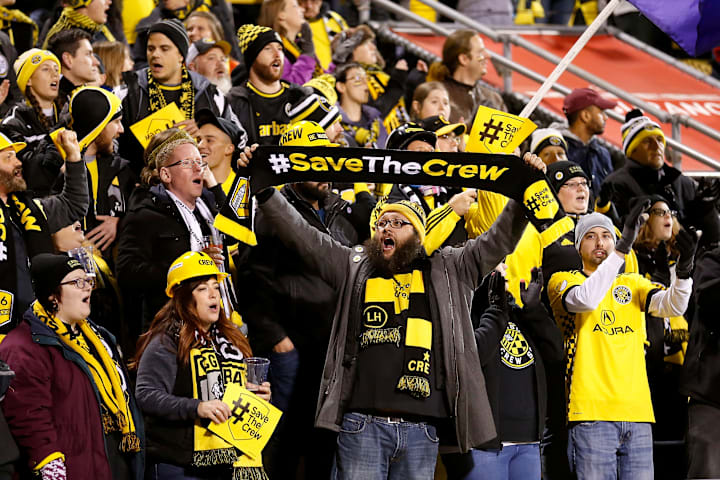
Before the movement's opening match—a 3–1 Vancouver victory over the Colorado Rapids—thousands of supporters packed downtown bars before marching toward BC Place, waving signs and banners and trailing colored smoke ahead of the stadium's final game before it hosts seven World Cup fixtures this summer.
Throughout the 90 minutes, the sold-out crowd of more than 27,000 raised Save The Caps signs, with additional displays reading "Hands off our team" and "We will fight for our club, and we will win," confronting the relocation rumors with fierce passion—and the hope that fan devotion can somehow help preserve the club.
"Hands off our Whitecaps."#SaveTheCaps ✊ pic.twitter.com/FsoUPaX3kU
The campaign draws its inspiration from the Save The Crew movement, a sweeping 2018 effort across Columbus and MLS to keep the Columbus Crew in Ohio, despite then-owner Anthony Precourt's plans to relocate the team to Austin. Precourt ultimately launched Austin FC, while the Crew stayed put.
While the Save The Crew movement relied on Ohio's "Art Modell Law" and pursued legal action, there is little question that the groundswell of support from Columbus fans and the broader MLS community to preserve a historic club made a real difference.
VANCOUVER IS A SOCCER TOWN #SaveTheCaps pic.twitter.com/DPqvphPzrL
"This is a really good opportunity to show whoever it might be that is going to be putting up money, that we really do love our club here," Nicoll says, noting that the Southsiders have connected with those who led the Crew campaign, even though no comparable legislation exists in British Columbia. "Culturally, this team is from 1974 and has been a huge part of this city over the last 50-odd years. You can't just throw that away... if we don't do anything about it, we'll be kicking ourselves."
Several other MLS supporters groups have already displayed the Save The Caps message, with banners spotted at Cascadia rivals Seattle Sounders and in Columbus—a trend that is only expected to expand.
"It of course becomes emotional," said Whitecaps manager Jesper Sørensen following the victory. "It's love from the fans to the team and to the players and to all of us, and it's a strong message—it's important."
Cascadia needs the Caps. #SaveTheCaps
ECS 4/18/26 📸 Hollie Coates-Seamster https://t.co/CxQkfgkaQJ pic.twitter.com/aGN0WeRIFu
What's Next for the Whitecaps?

Whitecaps CEO and sporting director Axel Schuster has stated the club is pursuing every possible avenue to stay in Vancouver, right down to "Plan Z"—which would mean relocation.
Yet more recently, he told The Guardian that "it might not be this year or next year—we might be done with the alphabet... What happens after the season, that's actually something nobody really knows. But it doesn't feel good."
The German executive has previously pointed to a $40 million revenue gap between the club and the rest of MLS, despite ranking among the league's top clubs in attendance. At its root, the absence of stadium control limits the team, preventing it from fully capitalizing on matchday income and ancillary events.
And unlike their American counterparts, the Whitecaps cannot tap into lucrative private healthcare sponsorships due to Canada's universal healthcare system. Meanwhile, provincial regulations restrict their activity in the gambling sector, further narrowing their commercial options.
BC Place, operated by PavCo—a provincial crown corporation—reportedly generates less than $3 per fan at each Whitecaps home match.

As one potential path forward, the Whitecaps are pushing to take over management of the government-owned venue to capture revenue from events and matches, believing they could generate significantly more. Meanwhile, the vision of a new club-owned, soccer-specific stadium at nearby Hastings Park remains at least five years away—and contingent on new ownership, at best.
#SaveTheCaps #VWFC pic.twitter.com/exSVsyod9c
When Vancouver billionaire Greg Kerfoot, as part of a consortium that includes NBA legend Steve Nash, brought the Whitecaps into MLS in 2011, the league was in an entirely different era. The difficult reality today is that MLS's extraordinary growth has left the Whitecaps' business model behind, even as the team continues to excel on the field.
Yet for Nicoll and the thousands standing beside him, hope remains that the city can avoid its most devastating sports storyline—especially as Vancouver prepares to host its first men's World Cup.
"The more support you can give, whether it's banners for your own clubs, your local MLS clubs, we just want people to know what's happening and to stand with us against relocation of the Whitecaps," he added. "All my friends and family are here, and the whole kind of social structure revolves around Whitecaps games. The Whitecaps are a huge part of my life, and so many of ours."
For now, the club keeps winning. The stands remain packed, and the city has fully embraced the team. But the future is not determined by results, and the Save The Caps battle is a far weightier matter than anything that happens on the pitch.