
NWSL Unveils Game-Changing High Impact Player Rule: What It Means for Women's Soccer
The National Women's Soccer League (NWSL) is preparing for significant changes to its roster regulations.
The league revealed on Tuesday that it was introducing a fresh player payment system aimed at giving teams greater freedom to sign and keep top-tier global talent. This innovative regulation has been named the "High Impact Player" rule (HIP).
Nevertheless, within hours of the NWSL's announcement of this new policy, the NWSL Players Association declared its strong disagreement. "The League's one-sided decision forces the NWSLPA to pursue action to protect the rights of the Players we serve," the NWSLPA stated officially.
According to the NWSL's statement, under the current collective bargaining agreement terms, the league had "used its authority to create the High Impact Player roster category and lower related salary cap impacts after consulting with the NWSL Players Association."
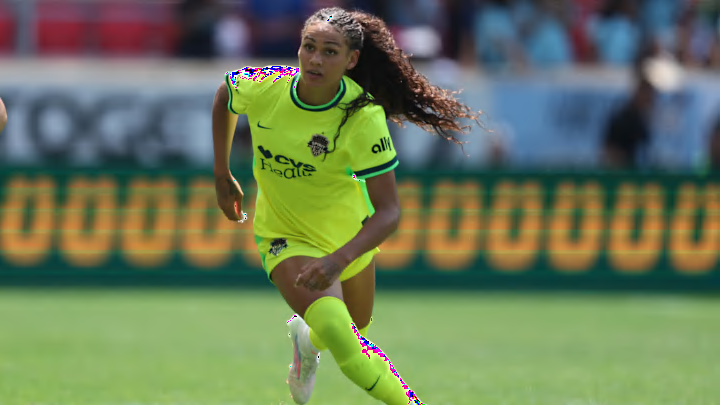
This development follows extensive coverage of the Washington Spirit's attempted deal with Trinity Rodman, which the league rejected due to payment structure issues.
How does the High Impact Player rule work?
Through the NWSL's new HIP regulation, teams may surpass the league's spending limit by as much as $1,000,000 for high impact athletes. This additional spending allowance will increase annually at the same rate as the salary cap.
The extra money can go toward one superstar or be spread across several athletes. Athletes compensated as High Impact Players will still count for at least 12% against the standard salary cap. For instance, in 2026, a High Impact Player will still occupy a minimum of $420,000 from the standard salary cap of $3,500,000. The HIP athlete would still receive more than this figure, but the excess funds would fall outside the standard salary cap.
Which players qualify as a High Impact Player?
Athletes must satisfy one of the following business or performance standards to be deemed a high impact player:
If an athlete meets any single criterion above, they can obtain up to $1,000,000 in additional compensation beyond the cap.
When does the High Impact Player rule come into effect?
The NWSL has stated that the High Impact Player regulation will take effect on July 1, 2026. This timing is primarily for operational purposes, and teams may begin contracting players under the High Impact Player regulation immediately. The compensation increase through off-cap spending will begin in the upcoming international transfer period, not the one officially starting Jan. 1, 2026.
Therefore, theoretically, a High Impact Player may join a team but won't receive payment from the new funding until July 1. The implementation date will be included in the new agreement, and the team cannot access the new funding before then.
Why is the NWSLPA opposing the rule?
The primary concern raised in the NWSLPA's statement is that the league failed to negotiate with the NWSLPA regarding this rule modification. The NWSL maintains it can enact the rule change without NWSLPA consent.
"According to federal labor regulations, modifications to salary cap compensation are mandatory bargaining topics—not matters of unilateral authority," the NWSLPA declared on Tuesday. "Equitable compensation comes through fair, collectively negotiated payment structures, not random classifications. A league that genuinely values its Players wouldn't hesitate to negotiate over it."
A major concern is that the High Impact Player rule compensation wouldn't be accessible to every player. The funding exists outside the salary cap, and athletes must qualify to receive it. This creates an exclusive system that advantages some while excluding other NWSL players.
The NWSLPA has expressed it is "prepared and eager to participate in honest negotiations" with the NWSL and suggested accepting a $1,000,000 salary cap increase instead of implementing the High Impact Player rule. This approach would theoretically make those extra funds available to more NWSL players and help teams compete better in the international soccer marketplace.
What next?
The NWSLPA has already submitted a complaint regarding the NWSL's rejection of the Spirit's contract proposal to Rodman on Dec. 3. That complaint remains active, and it appears the NWSLPA will now engage in another legal dispute over the league's choice not to negotiate the High Impact Player rule implementation.
These legal proceedings could continue for weeks or potentially months. There's no definitive schedule for when we might receive resolution on these regulations being accepted, denied, or completely reversed.
The pressing concern is that athletes like Rodman are currently without contracts. Time is critical. These players require certainty when signing agreements that will impact their futures and professional paths.
Additionally, the international transfer period will begin on Jan. 1, 2026, and potential players joining the NWSL will want clarity on teams' exact budgets and the compensation they can secure for next season and beyond.