
 ไทย
ไทย English
 中國人
中國人
In a final desperate attempt to secure their Premier League survival, Tottenham Hotspur have pulled out all the stops to appoint Roberto De Zerbi as their new head coach.
Following the dismissal of Igor Tudor after a dismal 44-day spell in charge, an embattled Spurs board were determined to bring in the fiery Italian despite opposition from sections of the supporter base and reservations from De Zerbi himself.
However, a lucrative contract offer proved too hard to resist, and the former Brighton & Hove Albion manager now faces the daunting challenge of keeping a club that considers itself among Europe's finest from dropping into the Championship and facing trips to Portsmouth and Preston North End next term.
How this drama unfolds over the coming months will be compelling viewing. De Zerbi is undeniably a talented coach, though one who perhaps became a little too aware of his own brilliance during his formative years in Italian football. He has produced some impressive work, yet consistent success at the very top level has remained out of reach.
Tottenham need him to deliver within just a matter of weeks, even though they've reportedly tied him down to a five-year contract.
De Zerbi has until April 12 to get his squad ready for the battle ahead, with Spurs next heading to Sunderland in the Premier League. Here's a look at how the Lilywhites might line up under their new boss.
Preferred 4-2-3-1
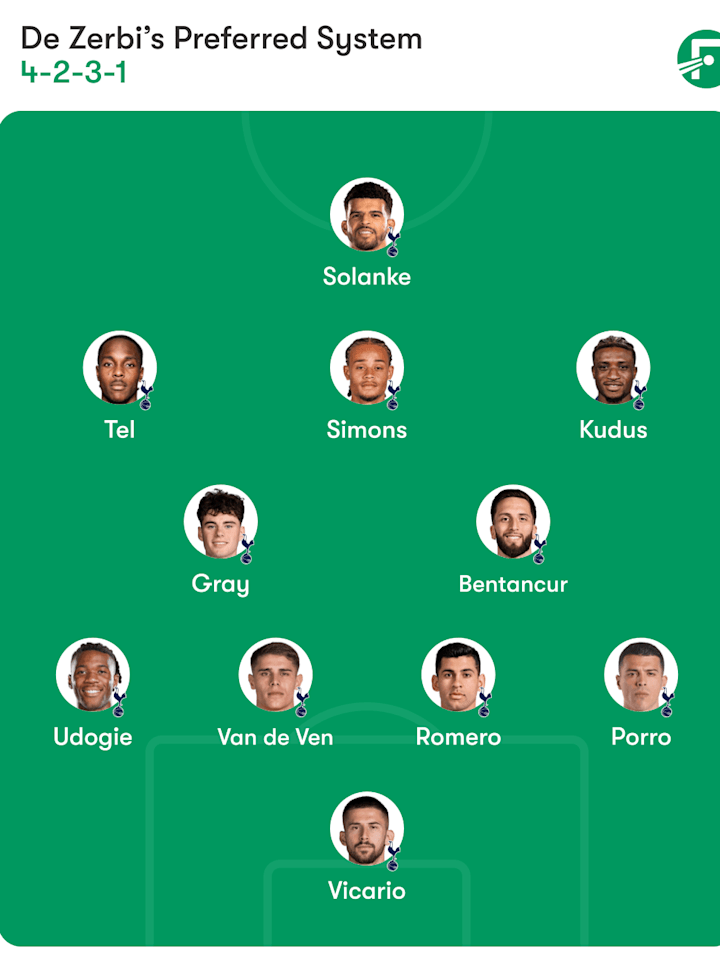
De Zerbi shifted his approach during his most recent stint at Marseille, but the 4-2-3-1 has been his go-to formation throughout his managerial career.
Should he return to his favored system in north London, he would be wise to harness the creative abilities of Xavi Simons in the number 10 role, even though the Dutchman has largely made his mark in the Champions League since arriving at the club.
De Zerbi's football philosophy revolves around manufacturing transitions by exploiting depth to advance up the pitch. Players must be courageous and technically sound in the build-up phase, with slick passing combinations needed to break through the opposition's press and allow attackers to burst into space with the ball.
Captain Cristian Romero and Pedro Porro are arguably the two most technically accomplished players in the Tottenham squad, making them crucial assets for De Zerbi. The Italian should look to shape his possession structure to get the best out of Porro's build-up quality and left-back Destiny Udogie's attacking runs. Micky van de Ven is more than capable of covering for Udogie when he pushes forward.
De Zerbi should also have additional midfield options at his disposal, with Archie Gray a near-certain starter based on his recent performances. Who partners him will be an intriguing decision, though Rodrigo Bentancur's experience could prove valuable once he returns from injury.
Bentancur can struggle in a deeper role, but he excelled under Antonio Conte in a system built on rehearsed patterns and automatisms. De Zerbi may also be drawn to Yves Bissouma, the most adventurous of Spurs' midfielders in possession, and Lucas Bergvall, who is a strong ball carrier.
Marseille Back Three

Both Thomas Frank and Igor Tudor turned to a back three during their respective tenures, though the latter was hampered by having to rely on Radu Drăgușin early in his short stint — a player who simply hasn't met the required standard.
De Zerbi made greater use of a back three at Marseille than at any previous club, and he may be tempted by a 3-4-2-1 if all three of Spurs' top center-backs are fit. Kevin Danso serves as a capable third option behind Romero and Van de Ven.
That said, neither Porro nor Udogie are natural wing-backs. Neither excels at creating space wide, with Porro more effective when building from deeper areas and Udogie at his best when driving forward rather than operating in a static wide position in the final third.
A 3-2-5 shape in possession would emerge with the wing-backs pushed high, leaving two attacking midfielders to support the lone striker. De Zerbi must make the most of the returning Mohammed Kudus across these final seven matches, and ensuring he has support rather than being isolated out wide would be a sensible approach.
The Ghanaian could link up with Xavi Simons in the half-spaces to form a box midfield, while Dominic Solanke looks set to lead the line. De Zerbi may be attracted to Randal Kolo Muani's fluid movement, but Solanke offers greater reliability in hold-up play and is also an effective presser.
Red Bull-Inspired Narrow Attack
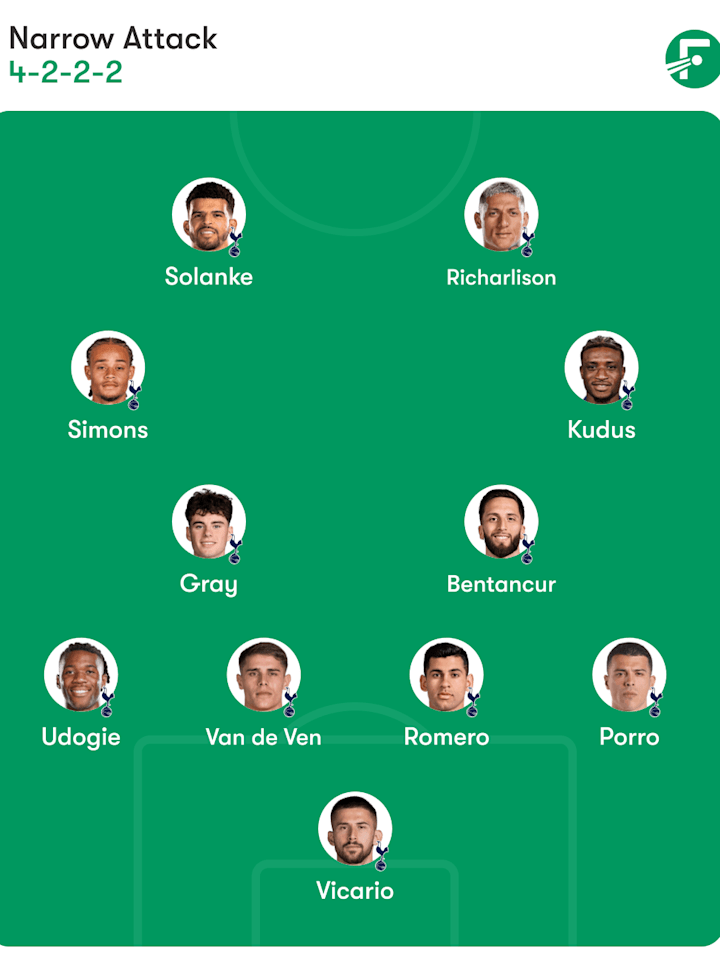
De Zerbi's admiration for Manchester City boss Pep Guardiola is well documented, with the Spaniard himself expressing appreciation for aspects of the Italian's work.
While De Zerbi has previously experimented with three-man defenses and diamond midfields, he may look to adopt an approach that Guardiola has been trialing this season. The City manager has placed increasing emphasis on central combinations within a narrow attacking structure, reminiscent of the 4-2-2-2 once popularized by the Red Bull coaching school.
Julian Nagelsmann, head coach of the German national team, is another prominent advocate of direct, aggressive attacking football through central channels.
It's a system that accommodates a front two — something Tudor used to good effect against Liverpool at Anfield — but it can only function effectively when technically gifted players operate in tight spaces together, with full-backs consistently providing width. The midfield pivot carries less responsibility in possession but becomes vital in shutting down counter-attacks.
Spurs' overall technical quality as a squad is limited, meaning a system reliant on quick combination play carries inherent risk. Nevertheless, it is precisely the kind of framework that could inject confidence into a fragile group of players.