
 ไทย
ไทย English
 中國人
中國人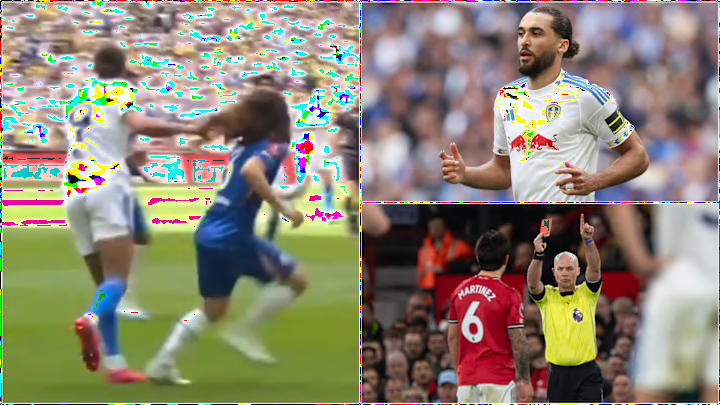
Dominic Calvert-Lewin faced no disciplinary action for an apparent hair pull on Chelsea defender Marc Cucurella during Sunday's FA Cup semifinal, coming less than two weeks after the Leeds United striker had been on the receiving end of a similar incident involving Manchester United's Lisandro Martínez.
Martínez received a red card for what appeared to be a brief tug of Calvert-Lewin's man bun during the Premier League fixture at Old Trafford, which Leeds went on to win. The moment was flagged by VAR, resulting in the Argentine defender's dismissal and an automatic three-game ban.
Just two days before the Chelsea-Leeds semifinal at Wembley, a regulatory commission on behalf of the FA released written reasoning explaining why Martínez's appeal had been unsuccessful.
There was a certain irony in Calvert-Lewin finding himself involved in another potential hair-pulling incident in a major match, this time as the one initiating contact. Viewers observed that midway through the opening half, Calvert-Lewin's hand appeared to make downward contact with Cucurella's hair.
As the Leeds forward withdrew his hand, Cucurella's long, curly hair flicked upward in the same direction, suggesting some form of pull had occurred. Cucurella also reacted instantly by reaching for the back of his head, as if he had felt pressure on his hair or scalp.
On-field referee Jarred Gillett did not address the incident in real time, but play was halted to allow VAR official Paul Howard to conduct a review. Calvert-Lewin was ultimately cleared of any wrongdoing, with the apparent justification being that contact was made with "the flat of the hand"—rather than a clenched fist—as reported by TNT Sports commentator Darren Fletcher, who had live access to the VAR dialogue and process.
Comparison With Lisandro Martínez, Failed Appeal

Drawing parallels with the Martínez incident was an unavoidable comparison.
Interim Manchester United manager Michael Carrick described that decision at the time as "one of the worst" he had ever witnessed. The club filed an appeal with the FA, arguing that Martínez had been wrongfully dismissed and that the accompanying three-match suspension was "excessive."
The appeal was dismissed on the grounds that the presiding regulatory commission did not feel "with any confidence" that the "force exerted" by Martínez on Calvert-Lewin's hair and scalp was "negligible." Calvert-Lewin's reaction was taken into consideration, as it "suggested that he had felt a certain amount of force exerted upon his hair/scalp." Consequently, VAR's interpretation of the incident as a hair pull was deemed "reasonable" and therefore not an "obvious error."
#MUNLEE – 54' VAR OVERTURN
After VAR review, the referee issued a red card to Martínez for violent conduct.
Referee announcement: "After review, Manchester United 6 is guilty of pulling his hair - violent conduct. Final decision is red card."
It was the conclusion of that ruling against Martínez that has left Manchester United supporters deeply frustrated and prompted the broader football community to question the consistency of officiating in England—a blatant hair pull by Fulham's Kenny Tete on Manchester City's Antoine Semenyo during a Premier League match in February also went entirely without punishment.
The Martínez ruling essentially established that hair pulling, regardless of severity, is inherently unacceptable and should be penalized accordingly to eliminate it from the sport: "In the wider interests of football 'hair pulling' ought not to be tolerated and should be discouraged through consistent punishment," the FA panel stated.
Yet an apparent hair pull by Calvert-Lewin, even if minor, was not handled in the same manner.