
 ไทย
ไทย English
 中國人
中國人
Argentina fell to Spain 1–0 in extra time during Sunday's 2026 World Cup final, failing to claim a historic back-to-back title in soccer's premier tournament — a feat last accomplished by Brazil back in 1962.
La Albiceleste could hardly be surprised by the result, having been thoroughly outclassed from the very first whistle at MetLife Stadium. Spain dictated the pace throughout, forcing Argentina into a reactive role — one that even a side renowned for late heroics couldn't overcome.
The South Americans managed just two shots over the full 120 minutes, neither troubling the goalkeeper. Spain, by contrast, racked up a staggering 20 attempts. The European giants were methodical, as they had been throughout the tournament, and their persistence paid off in the 106th minute when striker Ferran Torres finally broke the deadlock.
Following the grueling contest, Argentine icon Lionel Messi simply sat down on the pitch, legs stretched out, gazing upward to absorb it all — the defeat, the chanting supporters, the electric atmosphere. "The King is dead," the refrain echoed. The 39-year-old, appearing in a record sixth World Cup, may have just played his final international match.
Fortunately, Sunday also saw the coronation of a new king — Messi's worthy heir: Lamine Yamal. The 18-year-old sensation claimed World Cup glory 16 years earlier than Messi ever could.
Emiliano Martínez Played the Hero

The 33-year-old Argentine shot-stopper single-handedly kept his nation in contention for the bulk of a match they appeared to have no business being competitive in.
While Argentina's attack produced zero shots in 90 minutes — registering only two touches inside Spain's penalty area — the Aston Villa goalkeeper pulled off 10 saves, denying 1.75 expected goals during regulation and setting a new record for saves in a men's World Cup final.
Emiliano Martínez's standout save in regulation arrived in the dying moments of stoppage time, as he flung himself to the upper left corner to deny a free kick from Spanish sensation Yamal, sending the match into extra time. Spain had registered 15 shots by the end of 90 minutes, 10 on target, and ultimately needed 20 total before finally getting past Martínez.
His performance was made all the more extraordinary given that both starting center-backs in front of him were forced off through injury. Lisandro Martínez departed in the 44th minute, while Cristian Romero limped off in the 70th.
No Late-Game Magic for Argentina
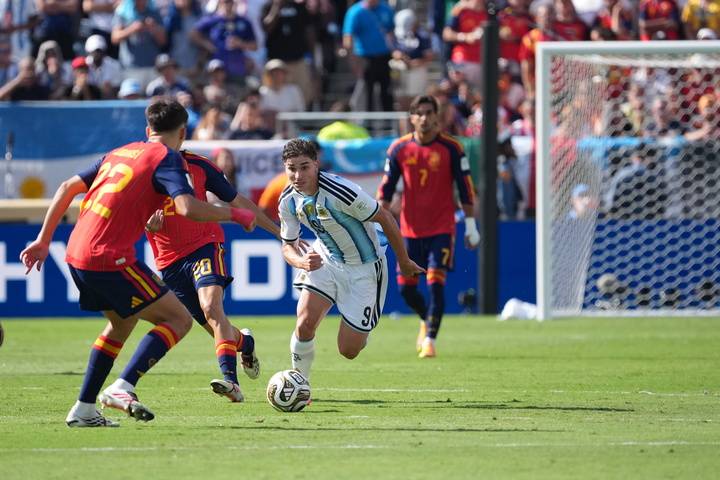
In each of their four previous matches, Argentina had conjured stunning comeback victories in the closing stages. By the time it happened for the third and fourth times — against Switzerland in the quarterfinals and England in the semifinals — it felt less like fortune and more like something supernatural.
Argentina had entered the final with 12 of their 19 tournament goals coming from the 75th minute onward, a figure never previously seen in World Cup history.
Even though Lionel Scaloni's side had created absolutely no attacking threat in the first 75 minutes against Spain, their late-game exploits throughout the summer still had fans holding their breath. But when the clock hit 75 minutes, Argentina failed to work their usual magic on Spain. If anything, the opposite unfolded.
Spain fired off seven shots in the final 15 minutes of regulation alone. Everyone anticipated Argentina seizing the moment, but it was a grip Spain never loosened. La Roja had commanded proceedings since the opening whistle of their very first match this summer, and even La Albiceleste — a side now infamous for injecting disorder into the most composed of situations — could not unsettle them.
Lionel Messi Can't Shine Without the Ball

Lionel Messi had thrived all summer precisely because every player in the sky blue and white around him worked tirelessly to deliver the ball to him in threatening areas. Critics questioned the approach — not only because Argentina boasts numerous other multi-million dollar talents capable of finding the net, but also because it left the team somewhat one-dimensional.
Spain had no need to man-mark Messi. They simply had to cut off every passing lane leading to him. This proved effortless — not so much because of defensive brilliance, but because Spain never surrendered possession.
Messi finished 120 minutes with a single shot and just 54 touches, none of which came inside Spain's box. It was a muted farewell for the soccer legend in what was likely his final World Cup appearance; yet it was hardly his fault. The 39-year-old had understood his limitations this summer and exploited his strengths brilliantly and consistently right up until the final. He was never going to have the stamina to cover ground for 120 minutes while Argentina played a man short from extra time onwards.
Messi's quiet outing also cost him a maiden Golden Boot award and left him short of the all-time World Cup goals record. He would have needed at least two goals and an assist, or a hat-trick, to overtake Frenchman Kylian Mbappé in the Golden Boot standings, and at least two goals to reclaim the all-time World Cup scoring record.