
 ไทย
 English
 中國人
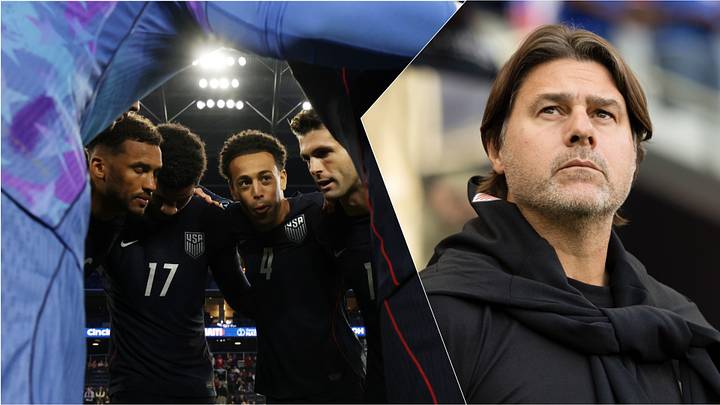
The Mauricio Pochettino chapter with the U.S. men's national team has officially closed. The Argentine coach wheeled his black luggage out of TQL Stadium on Tuesday evening, catching an overnight flight to England, where—jet-lagged—he has already begun his new role at Manchester United.
The 2–0 victory over Haiti in the second leg of the Concacaf Nations League quarterfinals served as Pochettino's farewell on the USMNT sideline, with two years of service honored by a leisurely lap around the Cincinnati field as the speakers pumped out the team's quintessentially American celebration anthem, John Denver's "Take Me Home, Country Roads."
The USMNT now turns its attention to the post-Pochettino era and the challenging task of identifying his replacement. It is a reality the players hardly expected so soon after the 54-year-old had signed a fresh long-term deal with U.S. Soccer, yet one that has already arrived at their door.
But as the team faces its uncertain future, there is little reason to worry. The USMNT will be perfectly fine without Pochettino, regardless of who takes over on the sideline. Not because his impact in the United States was insignificant, but rather because it was so deeply felt.
Pochettino Leaves Several Parting Gifts

Pochettino's negotiations with United may have been a whirlwind, wrapped up in just days amid the brief windows between training and film sessions he conducted for the USMNT; however, by the time he departed, he ensured the Americans were positioned in the best possible way for what lies ahead.
Tuesday's result stretched the USMNT's winning streak to six matches, including the landmark victories over Concacaf rivals Mexico and Canada the previous month. The team has yet to lose or draw since the World Cup, netting an impressive 20 goals across that stretch while conceding just three. The Stars and Stripes haven't enjoyed such a run of victories since the summer of 2021, when they strung together nine consecutive wins. Pochettino's successor will inherit a squad well-versed in winning convincingly.
"We have built this winning culture," star center back Chris Richards said on Monday. "... For us, it's going out there business as usual. We know that if we play to our ability, whatever [starting] 11 comes on the pitch, we'll get the job done."
Not only is the USMNT currently riding a dominant wave of form, but Pochettino also took care to secure several of its brightest young talents for the future. Last month, the manager conducted a thorough scouting sweep of the nation's most exciting prospects, calling up 12 newcomers—including eight teenagers—to the extended September-October camp.
"The one thing Pochettino really came into this federation with was a lot of ambition, a lot of goals not just for this team but also for the future of this team," Richards added. "You've seen these last two camps, a lot of young guys coming up. I think it's really important because obviously the national team is the best players in the country right now, but there is a future after this."

Several of those young players truly shone on the international stage and earned subsequent senior call-ups for the November camp, where Pochettino officially cap-tied them to the USMNT. On Saturday, the Argentine handed minutes to 18-year-old American-Polish striker Julian Hall, 17-year-old American-French-German winger Mathis Albert, 17-year-old American-Albanian midfielder Adri Mehmeti, and 19-year-old American-Uruguayan striker Justin Ellis.
Pochettino repeated the gesture on Tuesday, ensuring those players are now committed exclusively to the red, white and blue. He gave playing time to 20-year-old American-Peruvian-Venezuelan goalkeeper Diego Kochen, 19-year-old American-Haitian center back Neil Pierre, 17-year-old American-German-Bangladeshi forward Cavan Sullivan, and 22-year-old American-Colombian midfielder Santiago Castañeda.
Perhaps the most valuable parting gift Pochettino left the USMNT was a well-defined starting XI, finally establishing the ideal lineup to address the team's previous positional gaps. He deployed the same lineup in both competitive matches against Haiti, naming center back Auston Trusty as the rightful partner to Chris Richards and heir to veteran captain Tim Ream. Meanwhile, Kochen is the undisputed first-choice goalkeeper.
Pochettino's successor will not only inherit a winning team, but also a clear vision for the future and a defined starting XI for the present.
The Pochettino Legacy Lives On

Pochettino spent two years reshaping the entire identity of the USMNT, crafting a sense of purpose that every American player has come to embrace.
That identity was born from Pochettino blending distinctly American values with his South American philosophy. When he merged the two, they created a seamless partnership.
The fusion of the fiery "We're American, we don't take s---" mentality and the passionate South American style of play transformed the USMNT into the ultimate aggressor—a tactical brilliance that reached its peak at the home World Cup. Particularly in the group stage, the players were methodical, relentless hunters, surging up the pitch in rapid succession with dynamic, vertical movements—not recklessly, but with conviction.
"The aggression, the fight, Pochettino brings that South American spirit that we've been missing," USMNT veteran winger Timothy Weah said just before the tournament. "We've always been the good guys, so it's nice being on the other end and being the aggressor a bit."
The USMNT has since become defined by this swagger and competitive edge. These traits are now so deeply ingrained that the team plays with a chip on its shoulder even while dismantling a lesser side like Haiti.
MALIK TO MCKENNIE! ☄️#USMNT x @VW pic.twitter.com/yAwYscXMeE
The Concacaf Nations League quarterfinal tie was effectively settled after the first leg's 6–0 scoreline; however, the USMNT maintained its deeply embedded intensity, carrying the same energy and attacking aggression into the second leg.
"We don't think it's going to be an easy game just because we have a 6–0 goal difference right now," USMNT star midfielder Weston McKennie said Monday. "We're going to go into it just like the last game, with the determination to win."
The team immediately pressed Haiti from the opening whistle, generating three shots within the first four minutes alone. There was a sense of urgency from the players as though the aggregate score actually read 0–0. They found ways to express their creativity, exploit pockets of space, and push high up the pitch.
The fullbacks, Antonee Robinson and Alex Freeman, consistently held their positions high and wide along the touchline, allowing the midfielders to orchestrate controlled chaos through the center of the pitch. It was a demanding role for the midfielders, who were executing sweeping horizontal switches when not probing vertically; however, it is second nature to them at this stage.
In the brief spells without the ball, their high press was organized and menacing, and in transition, everyone—even striker Hall—worked relentlessly to track back defensively.
Even in the lowest-pressure situations, the USMNT has grown accustomed to performing this way. It is a foundation Pochettino built, and it is now firmly in place. With his departure, it will fall to the players themselves to uphold their identity—a responsibility they are confident they can shoulder.
"I think between the players, that is just something that we can continue, holding each other accountable, holding each responsible for the things we do on and off the field," McKennie added.
Star forward Christian Pulisic echoed the sentiment, telling TNT Sports after Tuesday's match: "We have such a good foundation. Nothing crazy is going to change. I think whoever comes in, we'll find a way to make it work. We're excited."