
 ไทย
ไทย English
 中國人
中國人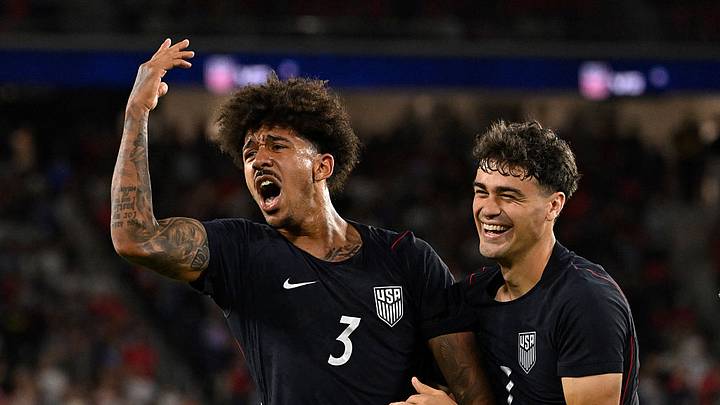
It wasn't pretty, and it even concluded with a bench-clearing brawl that sent manager Mauricio Pochettino rushing onto the field to separate players, but the U.S. men's national team managed to secure the victory.
In the second of four straight fall friendlies, the USMNT beat Chile 4–2 on Tuesday evening at St. Louis's Energizer Park.
Chile proved a far tougher opponent than Peru, whom the USMNT dispatched with ease in a 4–1 win over the weekend. Though the Americans still came away with three points on Tuesday, they found it difficult to break through La Roja's defensive shape and advance up the pitch. They were repeatedly crowded out and consistently made poor decisions under pressure.
Despite the relatively low stakes, the USMNT must reflect on its showing and make meaningful adjustments if it hopes to topple fierce rival Mexico in the third friendly on Saturday.
Here are three key takeaways from Tuesday's match.
Thwarted Midfield

From the first whistle and for much of the contest, the USMNT struggled to penetrate Chile's compact mid-block.
While the hosts controlled the lion's share of possession (65% in the opening half), they were largely reduced to non-threatening, sideways passing sequences. Whenever the midfielders attempted vertical or diagonal passes to break through Chile's tight defensive structure, those passes were either immediately intercepted, or the American receivers struggled to cope with the pressure bearing down on them and surrendered the ball with a careless touch. In short, the USMNT midfielders had difficulty adjusting to Chile's intense pressing and the speed at which the visitors closed down the ball.
The frustration of the situation seemed to only unsettle the USMNT midfielders further, causing them to rush on the ball and, as a result, fail to maintain proper possession. They were dispossessed repeatedly throughout the match.
17-year-old Adri Mehmeti and 21-year-old Brooklyn Raines, both making their first career starts for the USMNT, struggled the most in the center of the park, losing the ball a combined four times. They were largely invisible in attack, unable to find the right spaces or contribute to any meaningful build-up play. Even experienced campaigner Giovanni Reyna was guilty of a few giveaways. The only player who appeared capable of handling Chile's midfield intensity was veteran Sebastian Berhalter, though he ultimately couldn't carry the load alone, regardless of how many pockets of space he found.
Beyond Chile's undeniable intensity, it was perhaps the lack of chemistry among this new generation of USMNT midfielders that worked against them. With time and more repetitions together, they should be able to connect more quickly and fluidly. One bright spot from the midfield display was the ease with which they rotated positions throughout the middle third, even if it didn't translate into meaningful attacking moments.
Sloppy Defense

Compounding the midfield struggles was the sloppiness of the backline, particularly in possession. Center back Neil Pierre and fullback Frankie Westfield — both making their first senior starts — repeatedly played the ball directly to opposing feet, whether on the ground or via long balls. Likely a product of nerves on the international stage, their errors nonetheless kept the USMNT constantly on the back foot.
Chile's opening goal came after the backline failed to properly deal with a corner kick. As the ball pinballed around the penalty area, the defenders were passive, watching it rather than stepping up their line to catch eventual goalscorer Felipe Faúndez in an offside position. That was one of seven corners the backline conceded in the first half alone — the most in a single half since the 2014 World Cup.
Westfield was reckless in his forward runs and struggled to recover defensively, leaving his left flank exposed to the dangerous winger Maximiliano Gutiérrez, which directly led to Chile's second goal of the evening.
Dazzling Displays From Julian Hall

Julian Hall was the standout performer on the night.
In his first senior start, Hall served as the primary attacking threat for much of the match, adapting impressively to the specific challenges Chile posed. The 18-year-old Red Bull New York striker recognized Chile's compact defensive block and worked intelligently to stretch the backline and open up space for the midfielders.
Crucially, Hall identified that balls played over the top would be effective, and on the few occasions they were delivered, he made the most of every opportunity. He timed his runs into the final third to perfection, staying onside while leaving Chile's defenders scrambling. He finished the night with the joint-highest shot count (five) and the most touches in the opposition's box (nine).
Hall demonstrated his mature footballing intelligence throughout the match, but one moment in particular stood out above the rest. Receiving a cross from Sergiño Dest in the 37th minute inside the 18-yard box, and despite having a narrow opening to shoot himself, he opted to dummy the ball, recognizing that Berhalter was making a run behind him toward the back post. With Chile's defenders completely wrong-footed, Berhalter had a simple finish to give the USMNT the lead.
For the team's second goal, Hall did the finishing himself, netting his second strike in as many national team appearances. Latching onto a cross from Reyna, the youngster leapt to flick the ball toward the back post with a deft header.
"It's been incredible to share the pitch with such talented players," Hall said modestly after the match on TNT. "They put me in the right positions, and I'm just doing everything I can to convert those chances."
Though the USMNT added two further goals before the final whistle, it was ultimately Hall's influence that gave the team its attacking edge throughout the night.