
 ไทย
 English
 中國人
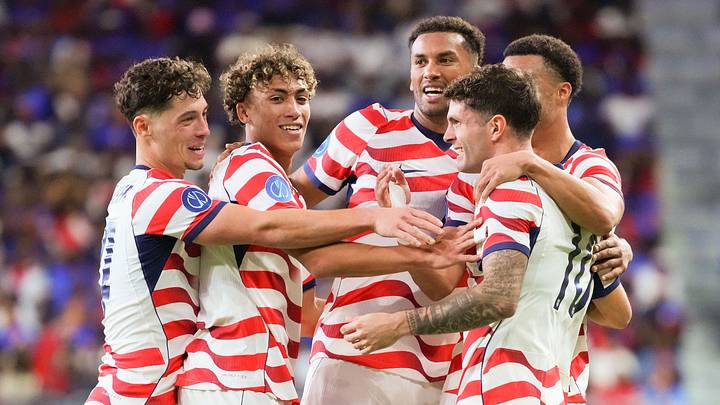
Looking toward 2027, the U.S. men's national team faces a challenge it hasn't encountered in more than two years: competing in a match on foreign soil.
As a new chapter begins with Mauricio Pochettino stepping away from the USMNT dugout to take charge at Manchester United, whoever U.S. Soccer Federation names as his replacement will step into a vastly different situation than the one Pochettino faced when he took over in 2024.
Pochettino enjoyed the benefit of inheriting a USMNT squad that, as a co-hosting nation, bypassed the qualifying rounds and earned automatic entry to the 2026 World Cup—where the Stars and Stripes contested every match of their tournament run on home turf. With the Concacaf Gold Cup and Nations League finals also held exclusively on U.S. soil, chances to compete abroad became even more scarce.
Consequently, Pochettino will depart the USMNT having overseen 37 matches in the role, yet only one required his side to venture beyond U.S. borders. It's a remarkable statistical oddity, and his replacement won't enjoy the same comfortable circumstances.
The Last Time the USMNT Played Outside of U.S. Soil

You have to rewind to the third match of Pochettino's tenure to find the last occasion the USMNT competed away from home. On Nov. 14, 2024, Ricardo Pepi's early strike proved sufficient as the USMNT defeated Jamaica 1–0 in the opening leg of the Concacaf Nations League quarterfinals.
The USMNT has since played 34 consecutive matches on U.S. soil, and by the time 2030 World Cup qualifying gets underway, it will have been nearly three years since that win in Kingston, Jamaica.
Naturally, USMNT newcomers Julian Hall, Cavan Sullivan, and Justin Ellis, among others, have never featured in an international fixture outside the U.S. Even at club level, Sullivan is the only one who has appeared in an official match on foreign ground.
Yet even seasoned internationals and USMNT regulars like Alex Freeman and Sebastian Berhalter—both of whom ply their trade in Europe at club level—have never been called upon to represent the USMNT in a match played outside the country's borders.
Whoever steps in for Pochettino will need to prepare the squad for the obstacles that away qualifier fixtures bring. Even against weaker opposition, road matches within the region can be tricky propositions—as former head coach Jürgen Klinsmann discovered during the 2018 World Cup qualifying campaign.
USMNT Legends Warn Current Players of What Awaits in 2027

However, it's not just the USMNT's incoming manager who must brace for the demands of competitive away fixtures in Concacaf—the players themselves will need to adapt and perform in hostile environments far from home.
USMNT legends Landon Donovan and Tim Howard tackled the subject on their Unfiltered Soccer Podcast and shared that during their playing careers, deliberate efforts were made to schedule matches in tough away settings. The current USMNT crop, however, is heading for a serious wake-up call.
"It hardened us [playing away international friendlies]," Howard admitted. "It got us to where we wanted as a team. But you can't do that anymore, we've said it, the schedule doesn't allow U.S. Soccer to go: 'we're going to make these young boys uncomfortable, we're going to take them to Germany.' Can't do it, there's no windows."
"All those points are right," Donovan said. "But I will say, they are going to get uncomfortable real soon. When World Cup qualifying starts, they're going to pack their bags and some of these kids and men are going to see places they didn't know could exist in the world.
"They are going to be uncomfortable soon. I agree, I would like to see them in more challenging environments away from home. The problem is the last four years, we knew the World Cup was happening in America, so everyone wanted to come play us in America."
Donovan added: "But, you can definitely believe they are going to get some experience in the next few years."
USMNT's World Cup Qualifier Journey Isn't As Daunting Anymore

Fortunately for Pochettino's successor and the broader USMNT setup, the Stars and Stripes will have the opportunity to ease back into competitive away fixtures against some of Concacaf's lowest-ranked nations.
Concacaf has overhauled its World Cup qualifying structure now that the region is guaranteed six berths in the tournament—double the allocation from the last time the USMNT went through qualifying—following the expansion of the World Cup field to 48 teams.
As one of Concacaf's top-ranked sides, the USMNT will enter its 2030 World Cup qualifying campaign in Round Two as the top seed in one of six four-team groups. There, it will play home and away fixtures against some of the region's lowest-ranked nations.
Should the USMNT finish in the top two of its group, it will advance to the final qualifying round, which consists of three groups of four teams. Again, as one of the region's elite sides, the USMNT would enter as the top seed in one of those groups.
As a result, away trips to Canada and Mexico—presumably the other top-ranked sides in Round Three of the 2030 qualifiers—are unlikely to feature on the USMNT's road to the World Cup. The qualification route is considerably more manageable than in previous cycles, given that the USMNT suffered a road defeat to Canada in the 2022 qualifiers and has never beaten Mexico at the Estadio Azteca in a competitive fixture.
The 2030 World Cup qualifiers and the return to regularly playing away from home will undoubtedly test the USMNT and its next manager. Nevertheless, the Stars and Stripes possess the talent to navigate any challenge that arises and secure their place at the 2030 World Cup.