
 ไทย
ไทย English
 中國人
中國人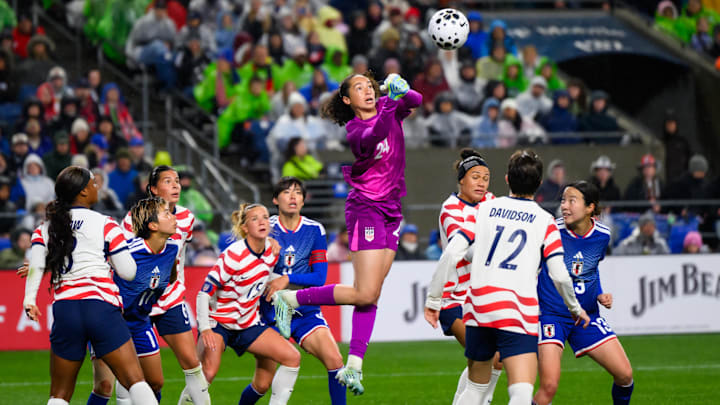
The U.S. women's national team suffered a 1–0 loss to Japan at Lumen Field in Seattle on Tuesday evening, with a record-breaking crowd of 36,128 — the largest ever for a women's sporting event in Seattle — braving a wet night in the Pacific Northwest.
Tottenham's Maika Hamano netted the game's only goal in the 27th minute. The 21-year-old forward dispossessed Ally Sentnor in midfield and, following a sharp passing sequence from Japan, cleverly cut inside before curling the ball into the top corner.
The loss levels the April friendly series between the two sides, after the USWNT claimed a 2–1 victory over Japan three days prior in San Jose.
This marks just the fourth loss for the USWNT under head coach Emma Hayes, who took charge in June 2024. Two of those losses have come against Japan. Hayes' overall record as USWNT coach now reads 31-4-2.
The USWNT will wrap up this three-game friendly series against Japan in the April FIFA window at Dick's Sporting Goods Park in Commerce City, Colo., on Friday. Here are the key takeaways from Tuesday night.
A brand new USWNT XI
With three straight friendlies against the same opponent, this window was always going to be about experimenting with different lineup combinations and testing relationships on the field. Hayes chose to overhaul her entire starting XI from Saturday's victory over Japan. While still a talented group, this was far from the USWNT's first-choice lineup, and the players struggled to find cohesion.
Apart from centerback Emily Sonnett — who would have featured in San Jose had she not picked up a knock in training — this was a youthful and experimental selection. Sonnett earned her 116th cap on the night, while the remaining 10 players combined had just 158 caps between them.
The USWNT's midfield was notably inexperienced. Claire Hutton, 20, wore the captain's armband, with 19-year-old Lily Yohannes and 21-year-old Jaedyn Shaw deployed ahead of her. Starting as the lone striker, 22-year-old Ally Sentnor appeared overwhelmed, losing possession 10 times and winning just 5 of 10 duels.
Captain Claire 🫡©️
Claire Hutton is the youngest to start a USWNT game wearing the captain's armband since 2001. pic.twitter.com/gHKuINXptj
"I think we've got players that have some of the ingredients, and they're trying to put it all together, but it's a work in progress. If I were purely focused on winning, we probably wouldn't change much in these games," Hayes said of her team selection.
"I don't regret those decisions. I just know that when a player performs well against a certain type of opponent — say, teams we faced in January — I want to see how they hold up against Japan."
Japan stays fresh
In some respects, Japan followed a similar approach. Interim coach Michihisa Kano made nine changes to his starting XI from the 2–1 defeat a few days earlier. However, his selections included several more seasoned internationals, such as 35-year-old World Cup winner Saki Kumagai, in-form 31-year-old forward Mina Tanaka, and 29-year-old fullback Risa Shimizu.
One notable difference between the two teams' approaches has been Kano's willingness to rotate more frequently during matches. He made nine substitutions in the first game against the USWNT and eight changes on Tuesday in Seattle, compared to Hayes' four and six in the respective games.
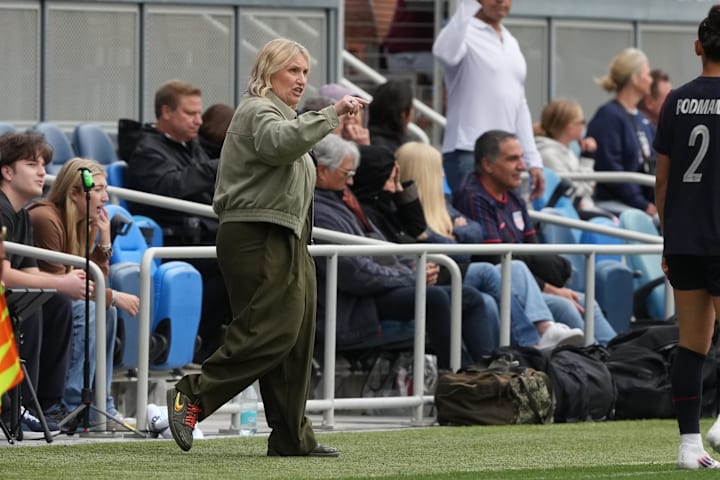
Japan has cycled through many different combinations throughout these games. But just a month removed from their triumph at the 2026 Women's Asian Cup, the togetherness of this squad is evident, and they slot into shape quickly regardless of the lineup. At this stage, Japan boasts greater match-ready depth than the USWNT.
Missed chances, U. S. fizzles out
With Japan protecting their early lead, the USWNT pushed hard in the closing stages. In the 65th minute, Hayes had seen enough from the young XI and made four substitutions at once, with a fifth following just six minutes later.
The introductions of Trinity Rodman, Sophia Wilson, Lindsey Heaps, and Gisele Thompson injected energy into the side. The USWNT quickly fashioned several opportunities to equalize, but lacked the composure and clinical edge in the final third. Sentnor was the most culpable, failing to convert the best chance from close range, while Shaw's effort from the edge of the box was deflected wide.
Although the USWNT created four rapid chances between the 71st and 74th minutes, Hayes's side failed to register a single shot after that point. The final 16 minutes and stoppage time exposed a blunt and disjointed USWNT unable to find a breakthrough. The Americans delivered plenty of crosses into the box, but Japan's backline dealt with them comfortably.
Overall, chances remained harder to come by than the USWNT would have liked, despite enjoying 67% possession. The USWNT registered 12 shots to Japan's nine and forced five saves from goalkeeper Akane Okuma.
"At the highest level, you have to be decisive in the box. Conceding a rather soft goal and not creating enough at the other end is what cost us," Hayes said of her team's display in Seattle.
Mixed night for Phallon Tullis-Joyce
Ahead of the match, Hayes had described Claudia Dickey and Phallon Tullis-Joyce as neck-and-neck in the race to become the USWNT's first-choice goalkeeper. Dickey may have edged ahead following Tuesday's performance, as it proved to be an inconsistent night for Tullis-Joyce.
In Seattle, the Manchester United shot-stopper appeared nervy in the wet conditions early on, scrambling to get a hand to a fierce Tanaka effort that dropped onto the turf. Tullis-Joyce then misjudged Hamano's match-winning strike, which sailed over her outstretched arms. Whether that was a matter of positioning or simply the quality of the finish remains open to debate.
Japan open the scoring in Seattle through Maika Hamano 🇯🇵 pic.twitter.com/tmQiWcU5dm
In the second half, Tullis-Joyce redeemed herself with a sharp low save to her near post from a Manaka Matsukubo effort — a stop that demanded excellent concentration, anticipation, and handling. She finished with a 97% pass completion rate and connected on 2 of 3 long balls. Her distribution will nonetheless face considerable scrutiny.
Tierna Davidson returns
In the 65th minute, Hayes made a change at centerback, introducing Tierna Davidson in place of Emily Sonnett. This was Davidson's first appearance for the U.S. since Feb. 26, 2025 — a match that also ended in defeat to Japan.
Davidson had suffered an ACL injury while playing for Gotham FC in the NWSL shortly after that game, going 412 days between international appearances. While her showing on Tuesday wasn't particularly eye-catching in either direction, her return is a significant lift for the squad.
"Tierna looked like she'd never been away. I thought it would be a tough game to come into, but she didn't show that at all. That's exactly what I was looking for — experience. And I think that made a difference," Hayes said.
More Women's Soccer from Sports Illustrated


Theo Lloyd-Hughes is a writer for Sports Illustrated Soccer based in the Southern United States. Originally from England, he can often be found in a press box across the NWSL or at international matches featuring the USWNT and other Concacaf nations.