
 ไทย
ไทย English
 中國人
中國人
A new chapter in soccer's rule transformation unfolded on the western side of the Atlantic on Saturday, as the innovative "Daylight Offside" rule produced its first goal in the Canadian Premier League.
The CPL, Canada's top-flight soccer division featuring eight clubs, is the inaugural league to implement the experimental rule, originally conceived by former Arsenal boss and current FIFA Chief of Global Football Development, Arsène Wenger. The rule permits an attacking player to occupy a traditionally offside position, provided that at least one body part capable of scoring remains level with or behind the second-to-last defender.
During the third weekend of the CPL campaign, Pacific FC forward Alejandro Diaz became the first player to score under the new rule, converting a rebound against the Halifax Wanderers in a situation that would have been ruled offside under the conventional rules applied across most of the globe.
The offside rule modification aims to promote more adventurous attacking play from strikers, with the intention of creating greater goalscoring chances throughout matches. Simultaneously, it seeks to eliminate contentious decisions, with offside only being called when there is a clear gap—the so-called "daylight"—between the attacker and the second-to-last defender.
As illustrated in the image below, Diaz occupies a traditionally offside position beyond Halifax's Lorenzo Callegari at the moment Pacific's Matthew Baldisimo strikes the ball, which determines his positioning for the rebound spilled by goalkeeper Marco Carducci. He subsequently slotted the ball into the open net, while multiple Wanderers players protested for offside.
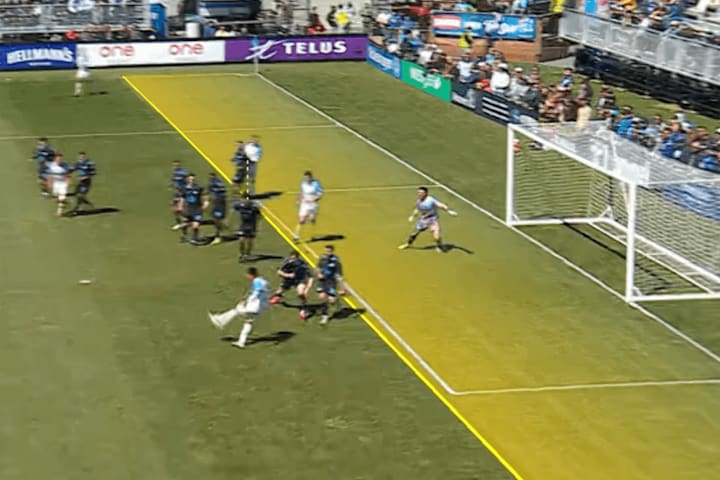
The incident underwent a short review before ultimately being upheld, marking it as the first goal officially scored under the new regulation. Nevertheless, given the nature of the rebound and the scramble in front of goal, it did not demonstrate any deliberate tactical adjustments by attackers or defenders, which are anticipated to develop as players and coaches grow more familiar with the updated guidelines.
Alongside the revised offside rule, the CPL has also become the first professional league to introduce Football Video Support, an alternative review mechanism to VAR, granting the league its inaugural video review capabilities, having previously never adopted VAR.
We saw the impact of Arsène Wenger's 'daylight offside' rule in the #CPLSoccer match between the Halifax Wanderers and Pacific FC
Here's how close Alejandro Díaz was to being offside on his goal📏 pic.twitter.com/7rr72O7qqQ
Under FVS, each club's manager is allocated two challenge cards per match, prompting the referee and fourth official to examine a play on a pitchside monitor using only broadcast camera angles. Through the opening weeks, the system has led to notable delays in certain matches, with reviews occasionally stretching beyond seven minutes for the most complex situations, generating considerable frustration among players, managers, and supporters.
Only three weeks into the season, the CPL is hopeful that the new regulations can attract greater attention to the league, while positioning itself as a testing ground for potentially landmark changes to the global game in the coming years—some of which may be addressed at the 76th FIFA Congress, set to be held in Vancouver, Canada, on April 30.