
 ไทย
ไทย English
 中國人
中國人
The White House stepped into the Falkland Islands controversy to back Argentina's players following a political banner displayed after Wednesday's semifinal victory over England.
Despite FIFA regulations prohibiting messages and statements "not appropriate for a sports event"—especially those "of a political, ideological, religious or offensive nature"—the White House is standing behind the right to free speech on American territory.
Andrew Giuliani, head of the White House World Cup task force, told reporters that the group of Argentina players who held up a banner reading "The Falklands are Argentine" were acting within their rights. "We believe in our First Amendment rights here in the United States of America."
While displaying the banner was not an illegal act, it still violates strict FIFA regulations, leaving Argentina vulnerable to potential sanctions. In 2014, Argentina's soccer federation (AFA) was fined the equivalent of $37,000 after holding up a comparable banner following a match against Slovenia.
It is worth noting that although the Falkland Islands holds the status of a British Overseas Territory, it is entirely self-governing in all areas except defense and foreign affairs. The islands were uninhabited before 1764 and have remained under British rule since 1833. In 2013, a local two-day referendum produced an overwhelming vote to remain a British territory. In response to the World Cup banner, the U.K. government reaffirmed its commitment to the Falklands.
One notable aspect is the view held by several prominent Argentine politicians that the opinions of those living on the islands regarding their status and future are irrelevant. Vice-president Victoria Villarruel had already inflamed the long-running dispute ahead of the semifinal.
FIFA Risks Double Standards by Not Punishing Argentina
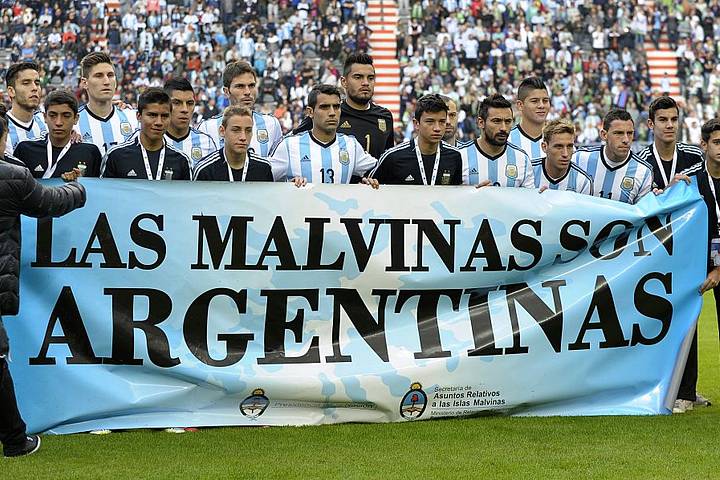
Failing to sanction Argentina would raise further questions of hypocrisy and double standards at a World Cup that has already been mired in off-field and administrative controversy.
Even beyond the existing sanctions imposed on Argentina following the 2014 incident, FIFA has established a clear precedent that leaves very little room for leniency here.
At the 2022 World Cup, FIFA threatened players planning to wear a OneLove rainbow armband in protest against host Qatar's laws criminalizing same-sex relationships with yellow cards. The move was widely condemned and underscored the governing body's firm commitment to strictly enforcing its rules on anything deemed "political, religious or personal messages or slogans."
England's FA stated it would "pay fines that would normally apply to breaches of kit regulations" but could not risk sporting sanctions that might result in players being "forced to leave the field of play." Germany protested the OneLove armband ban by posing as a team with every player covering their mouth with a hand to convey the message that "FIFA is silencing" teams.
In 2012, FIFA suspended Park Jong-woo for two matches after he displayed a banner asserting South Korea's claim over the disputed Liancourt Rocks.
Meanwhile, Spain players Álvaro Morata and Rodri each received a one-match ban from UEFA for chanting "Gibraltar is Spanish" in 2024. The incident occurred the day after the Euro 2024 final and did not even take place on a soccer pitch, illustrating the standards to which players are held.