
 ไทย
ไทย English
 中國人
中國人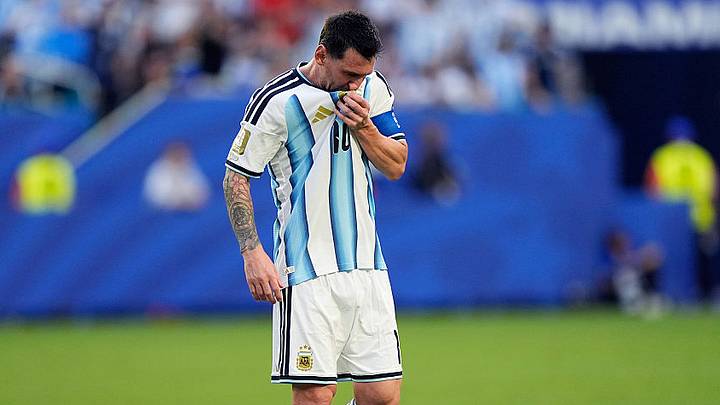
MIAMI — When Argentina's Lionel Messi claimed the 2022 World Cup title and the Golden Ball award, everyone said, 'Wow, what an incredible international career. Now he can finally rest.' When he returned two years later and lifted the 2024 Copa América trophy, people said, 'Wow, what a remarkable international career. Now he can rest.'
Nobody is more astonished than Messi himself to find himself back on the international stage, rather than relaxing on the sofa with a warm blanket and a steaming cup of yerba mate. The world wasn't even certain he would feature in the 2026 World Cup until manager Lionel Scaloni's final squad was announced just days before the group stage—the iconic forward had been hesitant to commit and likely hadn't even decided whether he was physically ready for the challenge.
Yet here he is, the only thing steaming being Messi himself under the scorching Miami sun, competing in a record-breaking sixth career World Cup at the age of 39.
Sorry, not just competing. Dominating. It took Messi a mere 28 minutes to reassert himself atop the Golden Boot standings, firing his seventh goal of the tournament past fan-favorite Cabo Verde goalkeeper Vozinha to put Argentina ahead 1–0 in the round of 32 clash at Hard Rock Stadium.
WIN FIFA WORLD CUP 2026™ FINAL TICKETS & OTHER PRIZES

Messi later delivered the corner kick that set up Argentina's long-awaited winning goal, a deflected header from Cristian Romero deep in the second period of extra time, allowing the defending champions to narrowly escape with a 3–2 victory over the tournament newcomers.
Messi may be redefining what it means to be in your late 30s, but his extraordinary ability to transcend the limits of time doesn't come without growing concerns about the overall state of the Argentina squad, particularly given the difficulty it had in overcoming World Cup debutants from a nation whose population is just one-sixth the size of Buenos Aires.
The former Barcelona icon has netted seven goals across just four appearances, one of which he didn't even start. That accounts for seven of Argentina's 11 total goals this summer—64% of the team's entire output. Messi won't play in sky blue and white forever—no matter how much his fitness levels and ability to carve through defenders half his age might suggest otherwise. Is the team dangerously over-dependent on its long-serving talisman? If so, what does this mean for the post-Messi era, whenever that day inevitably arrives? And who will inherit the torch burning with an entire nation's hopes, dreams, and collective identity?
Can any single Albiceleste player carry it the way Messi has—without getting burned?
Is Argentina Too Reliant on Messi?
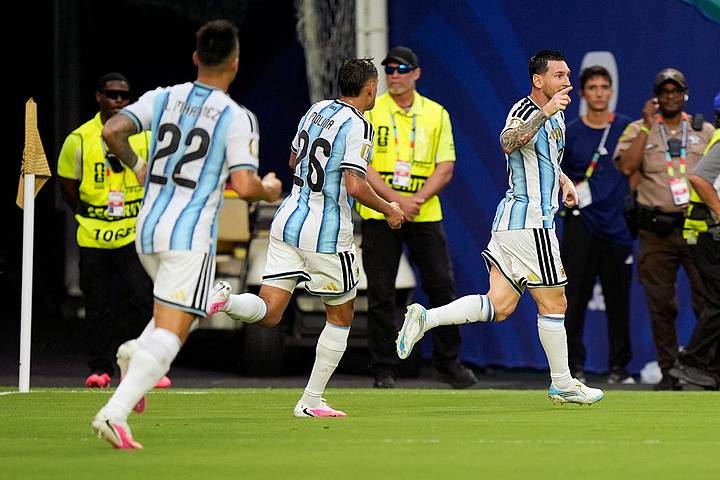
"Today, being 39 is so different than it used to be," Miami-based Argentinian supporter Lulu tells Sports Illustrated. "He has surprised a lot of people in these last few games."
Adds Tomás, who resides in Buenos Aires: "I didn't expect this level of performance, but we have to embrace it and ride the wave. He is our leader."
The fans may not have anticipated such brilliance from their aging star, but they always knew he would find a way to shine.
"Messi is a special player because he is so cerebral," says another Miami-based Argentinian fan, Lucas. "Everyone knew he would age gracefully because he's never relied on his pace to score or influence a match."
The team clearly understood this as well, perhaps growing too comfortable leaning on him at a time when it should be cultivating new sources of inspiration.
"In the last few matches, that could be the case," Tomás says regarding the team's over-dependence on Messi. "But we expect other players to step up in the coming games. Julián Alvarez, Lautaro Martínez need to improve a little, to perform better, so we don't rely entirely on Messi. We will need that."
Lucas argues, "It's a bit overstated, but the players do look to [Messi] because they all admire him. They were all kids when Messi turned professional."
There's no denying that Messi's teammates idolize him. Just look at the elaborate birthday celebration they organized for him two weeks ago, or the way everyone freezes in the players' tunnel until Messi walks past. It's as though these $100 million midfielders and world-class stars are instantly transformed into starstruck teenagers begging Messi for a photo.
It may take Messi's permanent departure from the pitch before La Albiceleste can even begin to imagine how they would function without him.
Passing the Torch in a Post-Messi Era
Any mention of an Argentina side without Messi is immediately met with sharp intakes of breath. When the forward went down after his head struck the knee of a Cabo Verde defender, fans desperately willed him back to his feet, chanting "Meeeee-ssi, Meeeee-ssi, Meeeee-ssi."
Yet if supporters were truly forced to envision a world without their No. 10, they don't believe it would be entirely bleak.
"[Giovani] Lo Celso was outstanding in the last match," Lulu says confidently about the left winger who opened the scoring in Argentina's 3–1 victory over Jordan. "In the last World Cup, Lo Celso couldn't play, but now he is so good, as were Lautaro Martínez and Julián Alvarez.
"Messi didn't start that game, and they still scored two goals...I know the team won't be the same without Messi, because Messi is Messi. But I believe in Argentina."
The fans also have faith in Argentina's emerging talent. Even if none of them can individually reach Messi's heights, they will be a formidable force as a collective unit.
Enable functional cookies to see this feature.
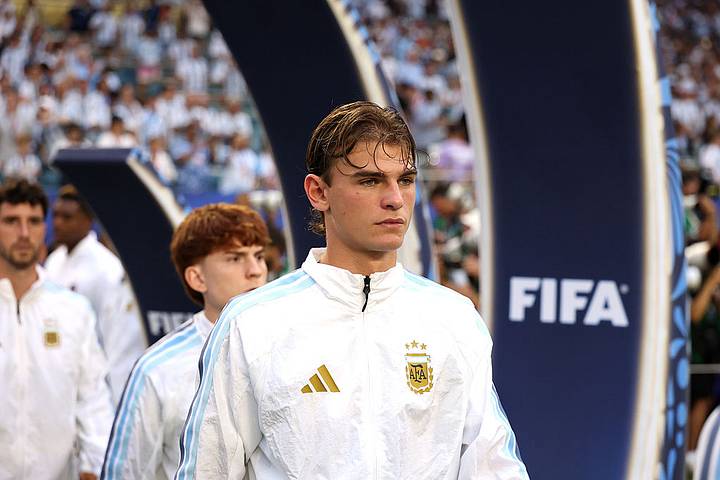
"Nico Paz, currently a substitute, has a bright future," Tomás says of the 21-year-old attacking midfielder. "There are other players not even at this World Cup. They're not at Messi's level, but together we will be a great team, not depending entirely on Messi's performances."
Lucas adds: "Nico Paz, Giuliano Simeone, Valentin Barco. The next generation is already waiting on the bench."