
 ไทย
ไทย English
 中國人
中國人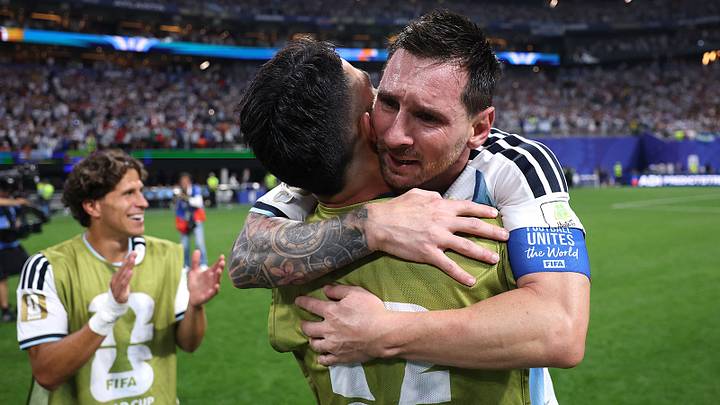
With barely 10 minutes remaining in Atlanta on Tuesday, Argentina's defense of their World Cup crown appeared headed for an embarrassing exit.
Having barely scraped past Cabo Verde—ranked 64th in the FIFA men's standings—in the round of 32, Argentina seemed to have finally met their match against an underestimated Egypt side. The Pharaohs caught the reigning champions off guard in the opening half, with defender Yasser Ibrahim nodding home Marwan Ateya's cross. After the interval, Egypt was sharp on the break, building a well-earned two-goal cushion, though they had a goal controversially disallowed for a foul in the lead-up.
Mostafa Ziko's strike left the soccer world in disbelief, with most observers convinced they were watching one of the greatest upsets the sport had ever seen. Yet it was not to be.
On 79 minutes, Argentina mounted the most dramatic comeback from two goals behind in World Cup history, with Cristian Romero powering in a header, before Lionel Messi smashed a half-volley off the crossbar and Enzo Fernández steered his header back across goal from Lautaro Martínez's delivery. The Argentina bench and supporters went into a frenzy.
For Egypt, the result was devastating. Manager Hossam Hassan made explosive allegations that FIFA had manipulated the tournament, pointing to several key refereeing decisions that went against his team. Ultimately, the match will be remembered as Argentina's miraculous escape, though it could easily have unfolded very differently.
What Was the Refereeing Controversy?
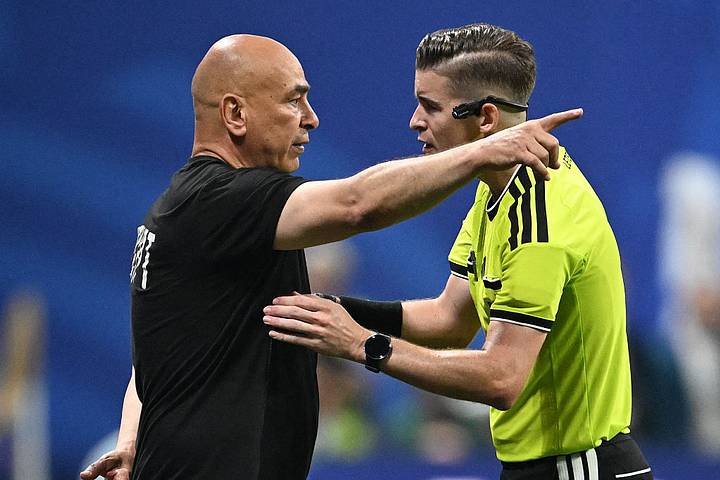
Hassan was visibly furious at the final whistle and had to be physically restrained from confronting referee François Letexier. Speaking to the media after the game, the Egypt boss accused FIFA of tilting the match in Argentina's favor, insisting his team had been subjected to a grave injustice.
The controversy centered on two incidents in the second half. Egypt believed it had extended its lead around the 60th minute, only for Mostafa Ziko's well-taken counter-attacking goal to be chalked off following a VAR review for a foul by Marwan Ateya in the build-up. Hassan was equally enraged by Letexier's failure to penalize a comparable foul against Egypt in the lead-up to Fernández's stoppage-time winner.
"It's all about money. They want Messi to remain in the competition," Hassan said in a fiery post-match interview. "In football, many things happen behind the scenes due to vested interests. What occurred was unjust. Egypt deserved to advance. We were the superior team.
"We have been wronged. This is my way of speaking out and taking a stand. I will not be watching another game in this tournament."
The World Cup's Biggest Shock Results

Whether Argentina advanced through brilliance, luck, or something more contentious is a matter of perspective, but what remains undeniable is that the world champions narrowly avoided joining the ranks of the most stunning upsets in World Cup history.
La Albiceleste is no stranger to such situations. The last time they conceded first in a World Cup fixture was the 2–1 loss to Saudi Arabia in Qatar in 2022. An early Messi penalty was cancelled out by Saleh Al Shehri's effort, before Salem Al Dawsari struck the shock winner. Following one of the most stunning results in world soccer, Scaloni's squad regrouped to top Group C and ultimately lift the trophy.
Three decades before Qatar, in what may have been an even more astonishing result, Argentina fell 1–0 to Cameroon in the opening match of the 1990 World Cup in Italy. The defending champions, led by Diego Maradona, were undone by a tenacious and underestimated opponent, with François Omam-Biyik's header proving the decisive blow.
A similar narrative played out in the 2002 tournament opener: Senegal 1–0 France, echoing Argentina's 1986 embarrassment as a defending champion falling to a far less fancied African side. Both Senegal and Cameroon went on to reach the quarterfinals in their respective tournaments, demonstrating just how severely they had been underestimated.
The 2002 World Cup is widely recalled as a tournament full of surprises. Co-hosts South Korea advanced all the way to the semifinals, defeating Spain 5–3 on penalties after a goalless draw through extra time. Prior to that, the Asian nation had eliminated Italy in the round of 16—though both matches are remembered as much for contentious officiating as for South Korea's remarkable performances.
That painful defeat for Italy was not the first time they had been beaten by a Korean side, having previously lost 1–0 to North Korea in the 1966 tournament.
Reaching even further back, one result widely regarded as the first true World Cup shock was USA 1–0 England in 1950. An overconfident England side arrived in Brazil ill-prepared for their debut tournament, having previously snubbed FIFA's invitations. A goal from Haitian-born Joe Gaetjens proved decisive for the American part-timers, and the result permanently altered England's perception of their standing in world football.
Biggest Rankings Disparity

In terms of FIFA rankings, Argentina's latest close call would have been a significant shock had it materialized, but it would not have come close to the greatest upset by rankings disparity—Argentina sits second to Egypt's 24th.
By that measure, as cited by Opta, the biggest upset in World Cup history is actually France 1–2 South Africa during the 2010 group stage, with a 74-place gap separating the European powerhouse (ninth) from the hosts (83rd). It is worth noting, however, that FIFA rankings were only introduced in 1994—well after the surprise victories of the USA or North Korea.
Enable functional cookies to see this feature.
In that match, a star-studded but aging French squad featuring Thierry Henry and Franck Ribery was stunned as South Africa broke the deadlock through Bongani Khumalo in Bloemfontein, with Katlego Mphela quickly doubling the advantage.
Florent Malouda pulled one back in the second half, but it proved insufficient as France was knocked out at the group stage for the second time in three tournaments.