
 ไทย
ไทย English
 中國人
中國人
With the 2026 World Cup now behind them, Mexico enters a new chapter under iconic former star Rafael Márquez, who has officially been appointed as head coach following Javier Aguirre's departure ahead of the 2030 cycle.
The transition plan in Mexico's coaching setup had been in motion since Aguirre returned for his third spell in charge after the 2024 Copa América. Márquez stepped away from his managerial position at Barça Atlètic (Barcelona's reserve side) and joined Aguirre's coaching staff upon his return to El Tri, serving as his assistant ever since. Following Mexico's exit from the 2026 World Cup, Márquez has officially been elevated to the top job.
"First and foremost, I want to express my sincere gratitude to Javier [Aguirre]," Márquez said in his opening remarks as Mexico's head coach. "He trusted me to be part of his staff. It has been an invaluable learning experience, which was always the intention."
The next chapter in our long-term project begins now.
As part of the continuity of the process that started two years ago, Rafael Márquez takes the next step in the planned transition by becoming Head Coach of the Mexican National Team.#SomosMéxico 🇲🇽 https://t.co/mfWuWbyF57
Following the loss to England that brought Mexico's World Cup run to a close in the round of 16, Aguirre was quick to offer Márquez his wholehearted endorsement.
"I had him as a player and now as a colleague — he's more than capable," Aguirre said. "I have nothing but gratitude for Rafa. I'm at his disposal and will always be nearby for whatever he needs, because he's a tremendous person, a proud Mexican, and an excellent coach — he'll prove it, just wait and see."
Who Is Rafa Márquez the Manager?
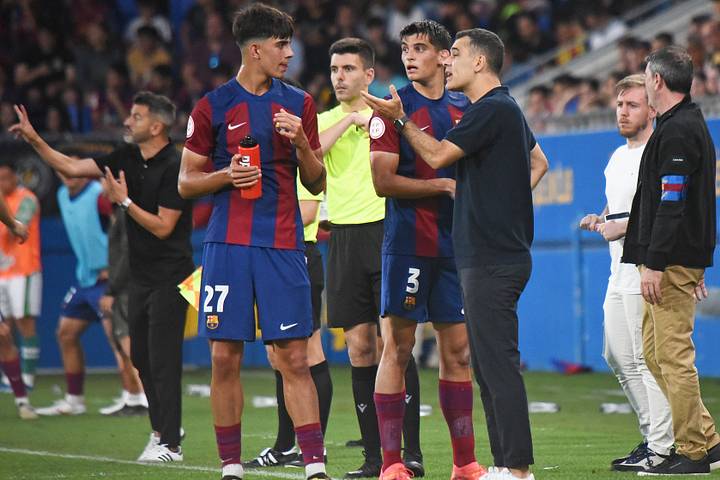
Márquez launched his coaching career shortly after retiring from playing in 2018. He had a brief spell with the youth setup at Spanish club RSD Alcalá in 2020, before club president Joan Laporta handed him the reins at Barça Atlètic ahead of the 2022–23 season.
With seven seasons as a Barcelona player and additional time managing the club's reserve team, it comes as little surprise that Márquez carries a strong imprint of the Blaugrana footballing philosophy.
Márquez predominantly deployed Barcelona's signature 4-3-3 system during his tenure, emphasizing a positional, possession-oriented style deeply rooted in Blaugrana culture — while also showing the flexibility to introduce variations, such as occasionally reshaping the midfield triangle to field two strikers. In his second season at Barça B, he came within one match of earning the team promotion to Spain's second division, falling 3–2 in the promotion playoff final against Córdoba CF.
During his time at Barcelona, he played a key role in the development of players including Marc Bernal, Marc Casadó, Pau Cubarsí, Gerard Martin, and Marc Guiu.
That said, while Pep Guardiola's philosophy is a significant influence, as Aguirre has noted, Márquez is not rigidly tied to the Barcelona model. His coaching outlook is also shaped by the various managers he played under, most notably Argentine tactician Ricardo La Volpe, who led Mexico at the 2006 World Cup.
WIN FIFA WORLD CUP 2026™ FINAL TICKETS & OTHER PRIZES

There Will Be Bumps Along The Road

There is plenty of reason for optimism given Márquez's credentials and Mexico's solid showing at the World Cup. However, his limited experience at the senior international level, the rising quality of Concacaf rivals, and the persistent structural issues within Mexican soccer mean the road ahead won't be without its challenges over the next four years.
It is well established that being among a nation's all-time great players does not automatically translate into managerial success. Hugo Sánchez, widely regarded as the finest Mexican player in history, lasted fewer than 18 months as El Tri's boss after succeeding La Volpe in 2006 — and Sánchez had two Liga MX titles on his coaching record.
Patience, and an acceptance that difficult moments will arise — as they have for every manager before him — will be essential for Márquez's tenure to flourish, even if patience has rarely been a hallmark of Mexican soccer's relationship with its coaches.
Poor results along the way would come as no great shock. Whether it's a road defeat to Panama or Jamaica in qualifying, or a failure to claim the 2027 Nations League or Gold Cup against the USMNT or Canada, how the Mexican football federation responds to adversity will ultimately shape Márquez's time in charge.
He also inherits a team riding an unprecedented wave of public support. Mexican fans are firmly behind El Tri after years of frustration, yet history shows that such enthusiasm can quickly turn to fierce criticism when results disappoint — a dynamic that has pushed the federation into hasty decisions in the past.
Márquez must navigate the inevitable setbacks that come his way, or there is no certainty he will see out the full four-year cycle.
The Future Can Be Bright

Despite the challenges ahead, it is difficult not to feel encouraged about what lies in store for El Tri. For the first time in more than two decades, a clear succession plan has been executed exactly as intended — as Márquez himself acknowledged — and the national squad is in a considerably stronger position than it was following Qatar 2022.
"I believe we have a very solid foundation," Márquez said of Mexico's current player pool. "We have young players and experienced ones who will be crucial during this transitional phase. So this is not the time to ease off — it's time to push forward."
Several Mexico players who shone this summer could be on their way to European football in the coming years. Additionally, Mexico's scouting and youth development infrastructure has improved significantly under youth national team director Andrés Lillini — particularly in the recruitment of dual nationals such as Obed Vargas, Brian Gutiérrez, and Richard Ledezma. Márquez praised Lillini's work since taking on the role in 2023 and emphasized that continuing to channel young talent into the senior setup will remain a top priority.
Another factor working in Márquez's favor is Concacaf's revised World Cup qualifying format. Returning to the qualification process after a four-year break will bring more competitive fixtures to El Tri's calendar, but with the new structure making clashes against the USMNT and Canada less likely, Márquez's Mexico may sidestep the kind of damaging results that have cost previous managers their positions in recent memory.
Mexico may not be co-hosting the World Cup in 2030, but there is genuine reason to believe that the groundwork laid this summer can yield an even more formidable side four years from now.
With a strong foundation in place, a well-structured coaching setup, fan backing at record levels, and a smooth handover completed, Márquez steps into the role as Mexico's manager ideally placed to build on El Tri's impressive 2026 World Cup campaign. His target for 2030? Aguirre summed it up perfectly in his final press conference as Mexico's head coach.
Enable functional cookies to see this feature.
"Hopefully he does better than what we achieved under my watch."