
 ไทย
ไทย English
 中國人
中國人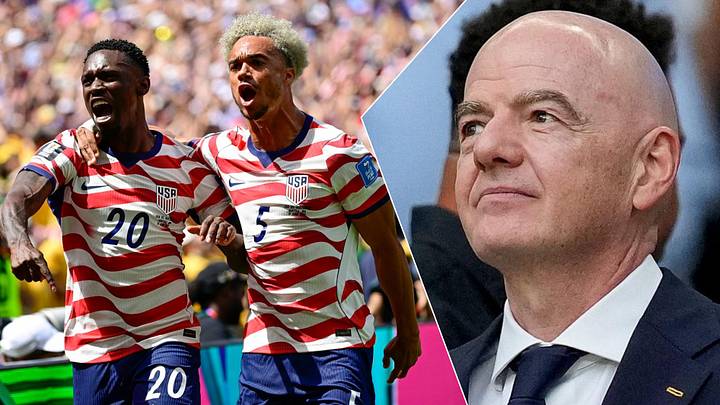
FIFA found itself at the center of controversy on Sunday after deciding to permit Folarin Balogun to feature for the USMNT in their round of 16 clash against Belgium.
Having been controversially dismissed for a foul on Tarik Muharemović during the round of 32 win over Bosnia and Herzegovina, the American forward was originally expected to sit out the Belgium fixture due to a one-match ban.
Yet, to the surprise of many, FIFA's Disciplinary Committee chose to suspend the 23-year-old's ban for a full year, enabling him to participate in the crucial knockout stage encounter. Should the USMNT defeat Belgium, they would advance to the World Cup quarterfinals for the first time since 2002.
It has since emerged that the White House made contact with FIFA President Gianni Infantino, requesting a review of the red card, and U.S. President Donald Trump has since expressed his gratitude to the governing body following its ruling to allow Balogun to take the field at Lumen Field on Monday.
However, FIFA's ruling is not without precedent. A comparable decision was made last November when reviewing Cristiano Ronaldo's red card in a World Cup qualifier, which had threatened to rule him out of the first two matches of this summer's competition.
How FIFA's Disciplinary Committee Works

FIFA's Disciplinary Committee is a judicial body responsible for enforcing the governing body's Disciplinary Code. Its duties include rescinding, upholding, or extending player suspensions across FIFA competitions.
"The committee shall act in accordance with the FIFA Disciplinary Code. It shall take its decisions in the presence of at least three members. In special cases, the chairman may decide alone," states FIFA's official website.
"The Disciplinary Committee pronounces the sanctions described in the FIFA Statutes and the FIFA Disciplinary Code on member associations, clubs, officials, players, intermediaries and licensed match agents."
FIFA had previously maintained that red card suspensions could not be appealed at the World Cup, but has since made a remarkable reversal of that stance.
Article 27 of FIFA's Disciplinary Code stipulates that "the judicial body may decide to fully or partially suspend the implementation of a disciplinary measure."
WIN FIFA WORLD CUP 2026™ FINAL TICKETS & OTHER PRIZES
How Cristiano Ronaldo Decision Has Impacted the USMNT

In November, Ronaldo received a red card for Portugal during a World Cup qualification loss to the Republic of Ireland. The veteran captain visibly directed an elbow at Dara O'Shea, earning him a straight dismissal. Under FIFA's own rules, a sending-off for violent conduct should have resulted in a three-match ban from Portugal's subsequent competitive fixtures.
Since that was the nation's second-to-last qualifier, Ronaldo would have been suspended for the final qualification match and Portugal's opening two World Cup group games. This is where FIFA stepped in.
Ronaldo served his ban for Portugal's next fixture against Armenia, before the second and third games of his suspension were deferred for a year. FIFA cited the fact that this was the veteran's first red card across 225 senior international appearances as a key factor in granting him leniency.
This lenient treatment of Ronaldo served as a reminder that FIFA holds complete authority over its own disciplinary decisions, though it was not an isolated case. French center back Laurent Koscielny (2014), Croatian striker Mario Mandžukić (2014), and the Netherlands' Phillip Cocu (2006) all had bans that would have carried over into World Cup play suspended in recent history.
Why Balogun's Red Card Reprieve Is Even Worse
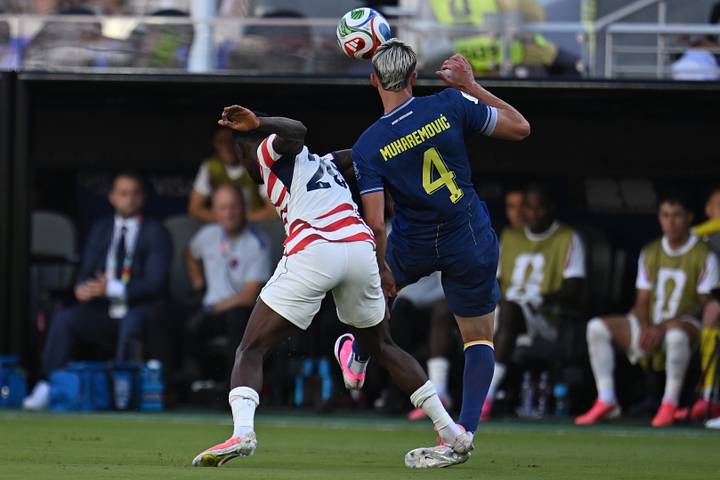
Ronaldo's preferential treatment was largely met with a resigned shrug. Balogun's red card reprieve, however, has sparked considerably more heated debate for several reasons.
For one, the ruling has come during the tournament itself, rather than in the lead-up to it. Unlike Ronaldo, Balogun may have some grounds to feel hard done by his dismissal—it appeared to be an unfortunate fall rather than a deliberate stamp—but the manner in which FIFA handled the process has been the primary source of outrage.
Enable functional cookies to see this feature.
President Trump's involvement inevitably clouds the waters of sporting integrity—it is difficult to interpret it as anything other than blatant political interference from a co-host nation—and FIFA has done little to address the situation by declining to provide any explanation.
At least Ronaldo could lean on the thin justification of being a first-time offender. Just why Balogun has been handed a reprieve remains entirely unclear.