
 ไทย
ไทย English
 中國人
中國人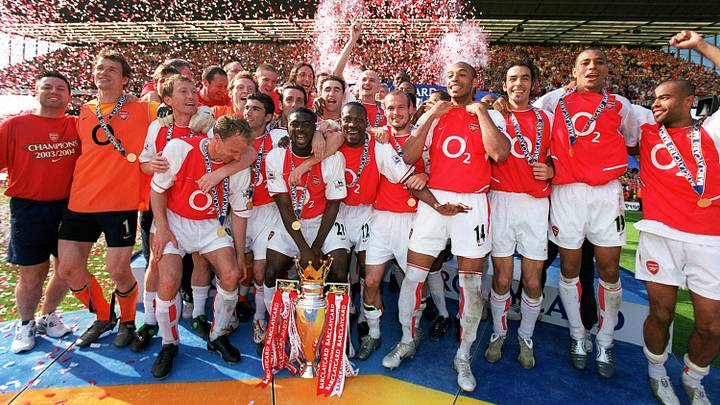
Arsenal stand among the most decorated clubs in Premier League history.
The Gunners have claimed four league titles—the fourth-highest tally in the competition—finished as runners-up a record nine times, and, most famously, remain the only club to complete an entire Premier League season without a single defeat.
The journey hasn't always been smooth, with Arsenal facing significant struggles in the league's early years and again after Arsène Wenger's exit. Yet amid the highs and lows have been some truly extraordinary campaigns—not just for the silverware collected, but for the players, performances, pivotal moments and exceptional quality on show.
With that in mind, here are our five greatest Arsenal seasons in Premier League history, ranked.
5. On the Right Track (2023–24)

Arsenal's 2003–04 "Invincibles" (more on them shortly) still hold the record for their highest Premier League points tally, with 90. But two decades on, the Gunners came closer than ever to replicating that feat, amassing an impressive 89 points in 2023–24.
The catch? It still wasn't enough. Arsenal walked away with only the Community Shield and ultimately surrendered the title to Manchester City after faltering at the crucial final stage.
So why does it feature among Arsenal's finest seasons? Because this was the campaign where everything finally seemed to click into place.
After two decades of disappointment, Mikel Arteta had assembled a side that looked genuinely capable of challenging at the very top. William Saliba and Gabriel formed a commanding defensive partnership, Declan Rice provided composure and intensity in midfield, while the brilliant Bukayo Saka had cemented his status as a genuine wide threat.
The foundations were firmly laid. Arsenal had the structure, the talent and the confidence.
Something special was just around the corner (pun very much intended) ...
4. Wenger Arrives in Style (1997–98)

When Wenger joined Arsenal in 1996, his appointment was greeted with considerable doubt. Players, fans and the English press struggled to grasp why the club had turned to a relatively obscure Frenchman whose most recent managerial role had been in Japan.
It didn't take long for Wenger to make his case.
In his first complete season, he steered Arsenal to the title in 1997–98. Bolstered by an expanding group of French talent—including Patrick Vieira, Nicolas Anelka, Emmanuel Petit, Rémi Garde and Gilles Grimandi—the Gunners recovered from a mid-season slump that had left them sixth and won 13 of their last 18 matches.
Even back-to-back defeats against Liverpool and Aston Villa in their final two games couldn't derail them. Arsenal finished a point ahead of Manchester United to secure their first league crown in seven years.
The FA Cup followed. A 2–0 win over Newcastle United at Wembley sealed the double and gave Wenger the ideal start to his English football career.
The skeptics had been well and truly silenced—and Arsenal's future suddenly looked extraordinarily promising.
3. Another Delightful Double (2001–02)

Following Wenger's sensational debut full season, Arsenal had to endure a four-year wait for their next major honour. When the trophies finally arrived in 2001–02, they came in emphatic fashion: another Premier League and FA Cup double.
This time around, Arsenal's title triumph felt even more authoritative. The Gunners went unbeaten after Christmas and won all 12 of their remaining fixtures, including wins over Tottenham, Newcastle and a decisive 1–0 victory at Manchester United with the championship at stake. They finished seven points clear in the end, though the gulf in class often appeared far wider.
Individual honours poured in as well. Thierry Henry claimed the Golden Boot with 24 goals, Robert Pirès was named FWA Footballer of the Year, Freddie Ljungberg took the Barclaycard Player of the Year award, and Dennis Bergkamp's stunning strike against Newcastle earned Goal of the Season.
It was, in every sense, a complete sweep.
Arsenal's FA Cup run saw them knock out Liverpool and Newcastle before meeting Chelsea in the final. A 2–0 win at Wembley rounded off another unforgettable double.
2. Back at the Top (2025–26)
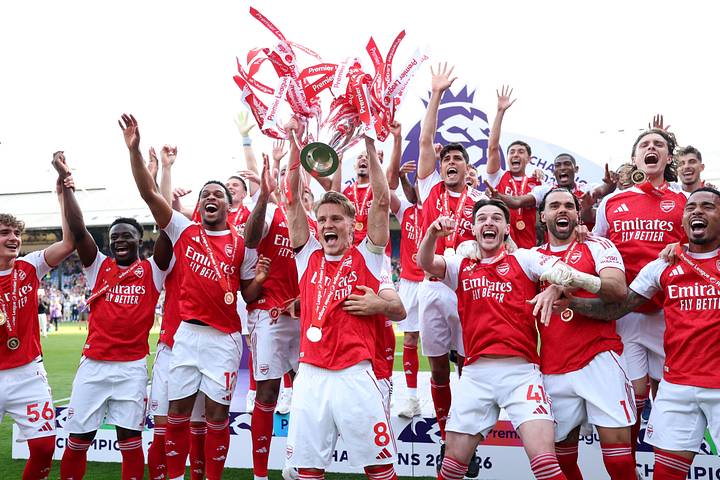
Arsenal had been gradually fading during the latter stages of Wenger's tenure, leaving Arteta with an enormous reconstruction task when he eventually took charge. It wasn't simply a matter of appointing a new manager—it required overhauling a squad whose best years had either passed or whose key figures had already departed.
Even after Arteta's arrival, improvement wasn't instant. The club, however, backed the process, affording the former Manchester City assistant the time needed to implement his philosophy, reshape the roster and assert his authority.
Three successive second-place finishes behind a seemingly invincible City side followed before Arsenal finally broke the cycle in 2025–26. Arteta had also evolved his approach along the way, gradually shifting from the expansive style he initially championed toward a more physical, pragmatic model built on set pieces and defensive solidity.
It wasn't always a spectacle, and it certainly didn't happen overnight. But after 22 years without a league title, Arsenal supporters couldn't have cared less.
1. "The Invincibles" (2003–04)
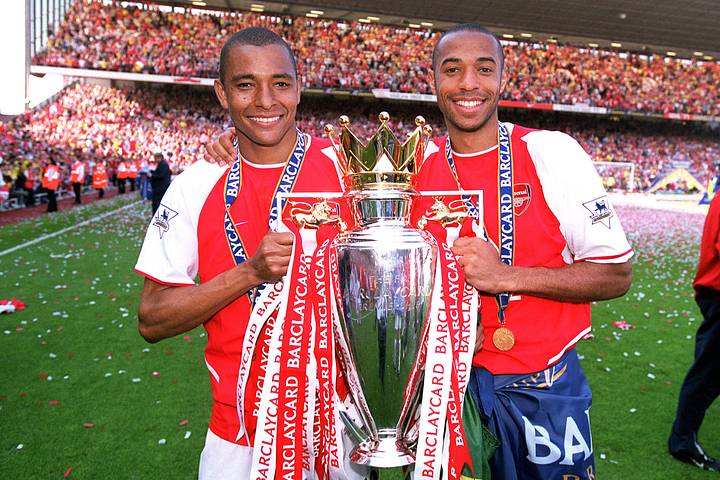
There was never any doubt about the top spot.
Arsenal's 2003–04 season wasn't merely their greatest campaign—it entered the realm of Premier League legend. Wenger's squad went the entire league season undefeated, becoming the first and only side in Premier League history to accomplish the feat.
Yes, 12 draws may slightly diminish the lustre of their 90-point total, but context is everything. This was a period when the gap between the division's strongest and weakest sides was considerably smaller, making Arsenal's 90 points and a mere 26 goals conceded all the more remarkable.
And what a squad it was. Henry led the line, Vieira commanded the midfield, Ashley Cole wreaked havoc from left back and the imposing Jens Lehmann was an immovable presence in goal.
This wasn't simply an exceptional Arsenal season. It was a historic achievement that continues to stand alone in Premier League history.