
 ไทย
ไทย English
 中國人
中國人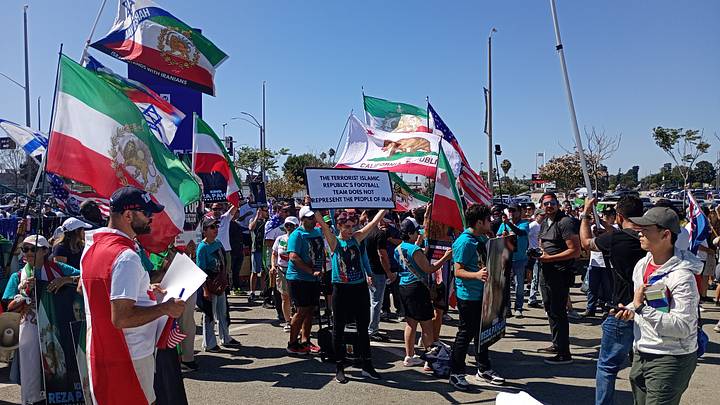
INGLEWOOD, Calif. — "Once the ball starts moving," Concacaf president Victor Montaglian remarked at a Business of Soccer conference in March, "somehow everyone forgets about everything else."
The balls have been in motion for five days now, yet virtually no one seemed the least bit interested in the on-field action of Iran's opening World Cup fixture against New Zealand on Monday.
At least two hours before the opening whistle, a sizeable crowd of fans wearing T-shirts emblazoned with "Iran is our temple, we will take it back," gathered along the south side of SoFi Stadium, brandishing placards, posters and flags.
The message could not have been clearer: "This is not our team."
Los Angeles is home to 166,000 Iranian-Americans, according to the UCLA Center for Near Eastern Studies's Iranian Diaspora Dashboard. One neighborhood in Westwood has such a dense diaspora community that it has earned the nickname "Tehrangeles." The majority of these residents are descendants of those who fled Iran following the Islamic Revolution of 1979, which toppled the Pahlavi dynasty and ultimately brought Ayatollah Khomeini to power as supreme leader.
Those who gathered for Iran's World Cup opener were staunchly opposed to the current regime and viewed the national team as, at best, a tool of propaganda — if not something far more troubling.

"These are all paid agents of the Iranian regime," the group's leader shouted through a megaphone. "These are not the true people of Iran. We are the true people of Iran."
This sentiment was widely echoed among those present.
"I am Iranian, but I hope New Zealand wins," Robert told Sports Illustrated just around the corner from the commotion of the protesters. "That team belongs to the regime."
Flags bearing a lion and sun — symbols from before the revolution that have since been banned by FIFA — were scattered throughout the area. The L.A. resident described these flags as the "real" flag of Iran.
Yet this was a cause that contained many layers.
'They Have No Choice'
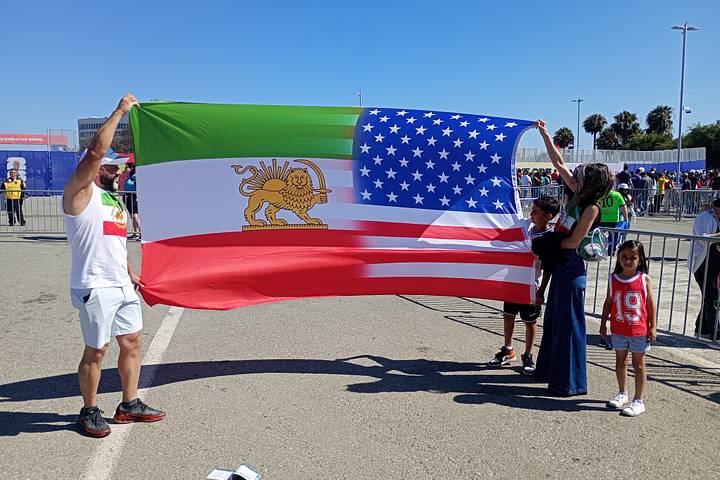
One supporter, Ramin, arrived with a pre-revolutionary flag woven together with the American star-spangled banner. "We don't support the team or the regime. We are here to show the world exactly what is happening in Iran," he told Sports Illustrated. "After what has happened in Iran — they are saying they killed over 40,000. My family is in Iran. The reality is they killed over 100,000 in just two nights.
"We are showing the world that this regime has nothing to do with this country, our people, or our history."
While he vowed not to celebrate if Iran scored — "not really" — Ramin acknowledged that the players have been placed in an incredibly difficult situation.
"Most of these players don't want to support the regime," he said, "but they're in a tough spot...They have no choice."



The squad has done its utmost to distance itself from the relentless political discourse. Iranian forward Mehdi Taremi told reporters the day before the match: "We are not here to engage in politics, we are here to play football." Yet that apolitical stance was never realistically going to hold.
"We are finished with this regime," Ramin said. "47 years is enough. Whether the U.S. wants to make peace doesn't matter. After mass killings, we have nothing to lose."