
 ไทย
ไทย English
 中國人
中國人
Switzerland forward Breel Embolo made World Cup history on Saturday by becoming the first player ever to be dismissed after receiving a second yellow card through a VAR intervention based on a highly specific interpretation of mistaken identity, during a thrilling quarterfinal clash against Argentina.
With the match tied at 1–1 in the middle of the second half, Embolo attempted to hold off Leandro Paredes. The 29-year-old was going to ground without being touched and extended his right leg, which made contact with the Argentine midfielder.
Referee João Pedro Silva Pinheiro initially cautioned Paredes, believing he had committed a foul. It quickly became apparent that wasn't the case, and the on-field official was called to the pitchside monitor by VAR. Following a brief review, Pinheiro reached a conclusion that outraged the Swiss camp and left everyone else puzzled.
Why Breel Embolo Was Sent Off for Switzerland vs. Argentina
After a VAR review, Embolo is sent off with his second yellow for simulation 🟥 pic.twitter.com/1ljSIAtVRj
Pinheiro explained his reasoning on the field. "After review," he announced to the stadium and viewers watching remotely, "there is no foul for [Argentina's] No. 5. And [Switzerland's] No. 7, there is a clear simulation. Final decision: Yellow card to No. 7."
Among the several new regulations introduced for this summer's tournament is one that permits VAR to step in when there is a case of "mistaken identity." Many pointed to this as the justification for Embolo's second yellow card—since Paredes was not the player who deserved to be booked.
However, mistaken identity can only apply when the referee "has clearly penalized the wrong player" for the offense in question. "The offence itself cannot be reviewed."
Paredes was cautioned for a foul, while Embolo was shown a yellow card for simulation—these are two entirely different offenses. Therefore, there was no true "mistaken identity"; rather, it was a misidentification of what the actual offense was.
Strictly speaking, Embolo should not have been penalized under the most precise reading of these rules. Nevertheless, prior precedent was not in his favor.
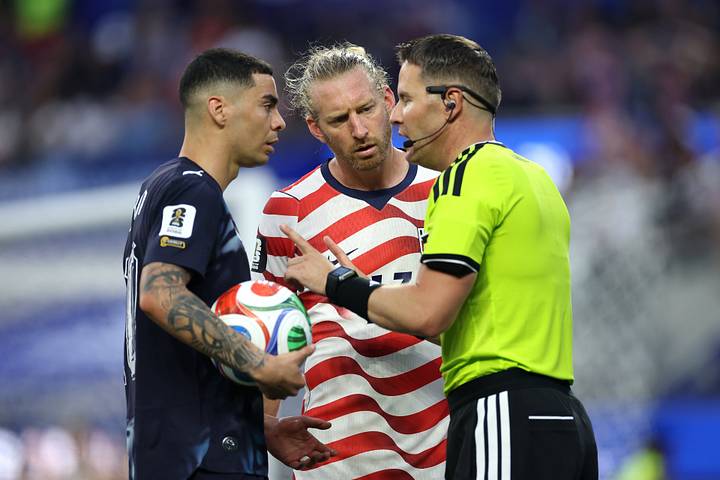
In the opening World Cup match on American soil this summer, a nearly identical situation unfolded. Tim Ream was initially booked for what referee Danny Makkelie considered a foul on Miguel Almirón. However, following a VAR review, the Paraguayan attacker was deemed to have dived, and Ream's yellow card was transferred to Almirón instead.
BBC Sport reported that several "well-placed sources" described the ruling as "wrong, even if it felt right."
Enable functional cookies to see this feature.
Nevertheless, the decision was widely praised—fans are always eager to see diving punished. The same report suggested that the positive public reaction to this technically flawed ruling has led FIFA to maintain this adjusted interpretation of the regulations.
Almirón had not previously been booked in that match against the U.S., so his yellow card drew little attention. Embolo's, however, proved far more consequential.