
 ไทย
ไทย English
 中國人
中國人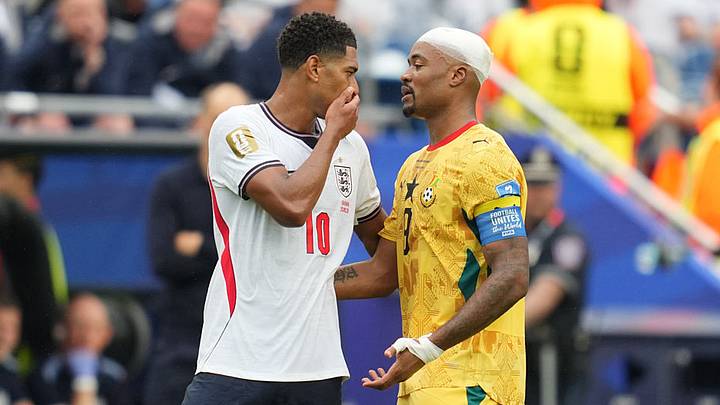
England midfielder Jude Bellingham was spotted shielding his mouth while speaking to Ghana forward Jordan Ayew during Tuesday's scoreless stalemate, leading many fans to question why he wasn't issued a red card under FIFA's newly introduced World Cup regulations.
The governing body stipulates that any player who covers their mouth while engaging in a confrontation with an opponent will be dismissed, a rule that saw Paraguay winger Miguel Almirón sent off in the first half of his team's 1–0 victory over Türkiye on Friday. The 32-year-old shielded his mouth during a dispute with Mert Müldür and faced the consequences.
Yet when Bellingham did something similar against Ghana, the Real Madrid star escaped without punishment. A red card would have ruled the 22-year-old out of England's group stage decider against Panama, but he remains available for the crucial fixture at MetLife Stadium, while Almirón must sit out a one-match ban.
There is, however, a crucial distinction between the two incidents that explains why Almirón was punished and Bellingham was not.

Why Bellingham Got Away With Covering His Mouth vs. Ghana

While Bellingham was involved in a tense exchange with the Ghana coaching staff at Gillette Stadium, his exchange with Ayew appeared to be entirely amicable. The pair seemed to simply be having a conversation, in contrast to Almirón, who squared up to Müldür after a skirmish erupted between Paraguay and Türkiye players.
ESPN reported that Bellingham's exchange with Ayew was considered non-"confrontational" and therefore did not merit a red card for the England international. Referee Hector Said Martinez Sorto made the correct call in allowing the No. 10 to remain on the pitch without any disciplinary action.
The ruling reflected the distinction outlined by FIFA's head of referees Pierluigi Collina ahead of the tournament.
"Players can continue to cover their mouth with an arm and the shirt because they may chat with friends," he said. "It's normal to chat before, during or after the match. So if the conversation is a friendly conversation, they can continue to do it without any problem.
"When the conversation is confrontational, covering the mouth means that you are doing something very wrong, potentially, and the sanction is the red card."
Where the 'Prestianni Rule' Originated
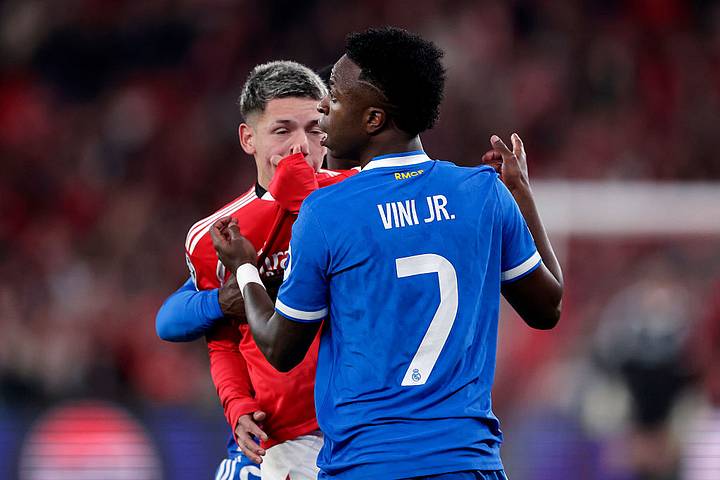
The new regulation introduced at the World Cup is known as the 'Prestianni Rule,' named after Benfica winger Gianluca Prestianni, who covered his mouth while allegedly directing racist abuse at Real Madrid star Vinicius Junior.
Prestianni denied the racism allegations, claiming instead that he directed a homophobic slur at the Brazilian, which resulted in a six-match UEFA ban that FIFA subsequently upheld. The disgraceful episode prompted the governing body to introduce the 'Prestianni Rule' to address players concealing their mouths when suspected of using discriminatory language toward opponents.
"This thing about covering the mouth is for us a very, very important rule," FIFA president Gianni Infantino told SNTV following Almirón's red card against Türkiye.
SI answers is our AI answer engine trained on human-created content.
"It's about respect. It's about the example that we should give. If you have nothing to hide, you don't cover your mouth when you speak to somebody.
"The rules have been made very clear to everyone."