
 ไทย
ไทย English
 中國人
中國人
Being a soccer referee ranks among the most demanding roles in professional sport.
Every call is analyzed, every error replayed from multiple angles, and criticism can come from players, coaches, supporters and journalists alike. On top of all that, referees must maintain excellent physical fitness, handle volatile personalities and stay calm while making instant decisions under enormous pressure.
It demands a truly rare combination of abilities.
One aspect of the role that frequently goes unrecognized, however, is communication. At club level, referees routinely oversee matches featuring players from across the globe, many of whom speak entirely different languages. Continental tournaments like the UEFA Champions League introduce further complexity, while at the World Cup, referees may find themselves trying to communicate with players from countries that share no common tongue whatsoever.
So how do referees convey their message? What language do they actually use when addressing players? Here's a look at how officials tackle one of football's most underappreciated challenges.
What Language Do Referees Speak at the World Cup?
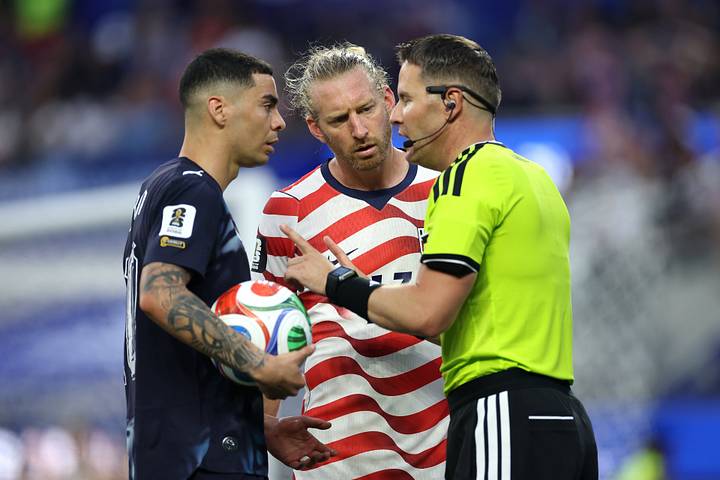
While soccer's rulebook is designed so referees can communicate through whistles, hand gestures, flags and cards, officiating a contemporary match without speaking would be nearly impossible.
Yellow and red cards were originally introduced to bridge language gaps at international tournaments, enabling referees to convey disciplinary decisions without relying on words. Today, however, verbal communication is a fundamental part of the role—whether it involves settling players down, clarifying decisions, defusing confrontations or announcing VAR rulings to the crowd.
At FIFA competitions, English functions as the primary language on the pitch. Officials selected for tournaments like the World Cup are expected to communicate confidently in English, which is also used for official match reports and other tournament paperwork.
FIFA also encourages referees to speak at least one additional official language—typically Spanish, French or German. Since many top-level referees hail from non-English-speaking nations, it is common for World Cup officials to be bilingual or even multilingual.
What Language Do Referees Speak in the Premier League and La Liga?
Domestic competitions are considerably more straightforward.
In the Premier League, officials appointed by the Professional Game Match Officials Limited (PGMOL) work in English, which is used for on-field communication, VAR discussions and official documentation.
The same logic applies in Spain, where La Liga referees conduct matches, liaise with VAR and complete all official paperwork in Spanish.
What Language Do Referees Speak in the Champions League?
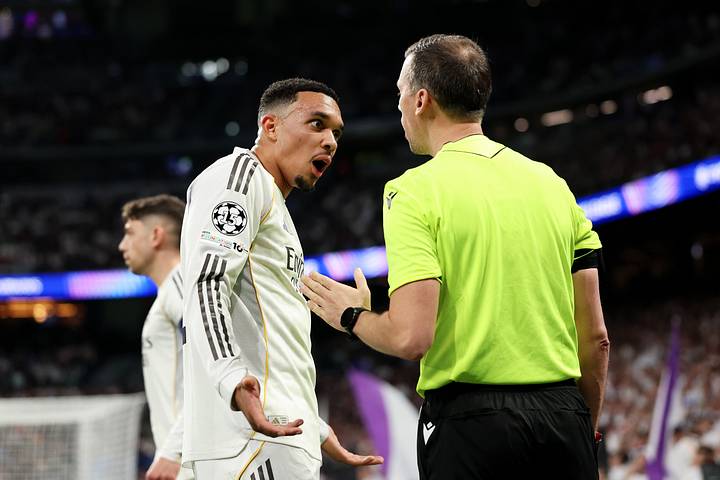
Much like FIFA competitions, UEFA—European football's governing body—uses English as the shared language for international fixtures.
Referees officiating in the Champions League, Europa League or Europa Conference League are expected to communicate in English, enabling them to manage players from a wide range of countries using one common language.
Enable functional cookies to see this feature.
That doesn't mean every player is fluent, but most professionals understand enough English to follow common soccer terminology and referee instructions, having played alongside international teammates throughout their careers.
And even when words aren't enough, soccer has its own universal language. A whistle, a pointed finger, a raised flag or a yellow card is understood in every corner of the world.