
 ไทย
ไทย English
 中國人
中國人
The controversy surrounding several Argentina players celebrating their 2026 World Cup semifinal triumph over England by displaying a banner reading "Las Malvinas son Argentinas" (The Falklands are Argentine) has predictably drawn scrutiny from FIFA and the international community.
The Argentine Football Association (AFA) may face disciplinary action, as FIFA's regulations are clear-cut regarding political statements.
Following the final whistle of Argentina's thrilling 2–1 victory in Atlanta, former Tottenham Hotspur midfielder Giovani Lo Celso was spotted retrieving a banner from supporters in the stands before raising it alongside teammates including Lisandro Martínez, Cristiano Romero and Nicolás Otamendi, with additional players celebrating around the banner as it was eventually placed on the pitch.
The banner references the Falkland Islands (referred to as Las Islas Malvinas in Argentina), a cluster of South Atlantic islands situated approximately 300 miles off the Patagonian coastline, which function as a British Overseas Territory. Argentina disputes their sovereignty, and a ten-week conflict in 1982 resulted in the deaths of 649 Argentine and 255 British soldiers.
Responding to the banner controversy, outgoing UK prime minister Sir Keir Starmer stated: "The World Cup might not be ours, but the Falkland Islands definitely are. Our position is unchanged. Self-determination rests with the islanders and our commitment to the Falklands will never waver.
"More broadly, potential action is a matter for Fifa, but it's been a fantastic World Cup and we've said throughout that politics should stay out of football."
UK business secretary Peter Kyle described the incident as "an egregious violation of the rules of not having political activity as part of the football."
Paredes Defends Actions of Players
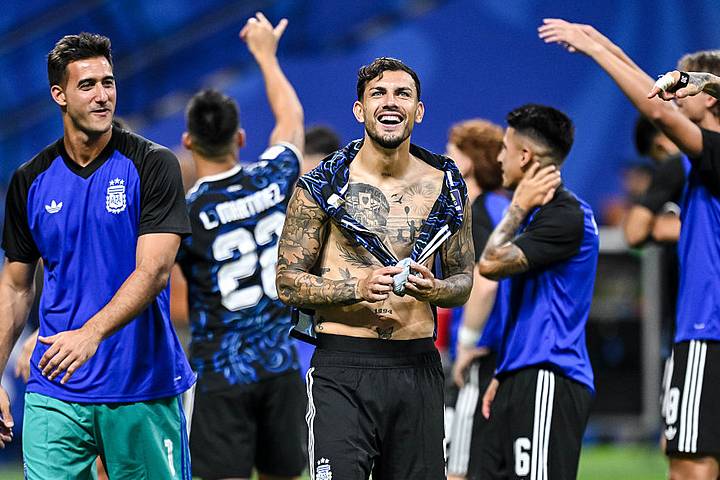
Before the match, Argentina head coach Lionel Scaloni had stressed that his squad was focused solely on the game itself, a stance that was contradicted by his players' subsequent actions.
Addressing the controversy, midfielder Leandro Paredes stood by his teammates, saying: "It was a painful chapter in our history for everyone involved, and it still hurts.
"We knew we were playing for all our people, our whole nation. I believe we handled it in the best way we could. We wanted to show that for us this was more than just a soccer match. It was hugely significant for the entire country and I think we feel overwhelming joy."
Speaking to reporters on the pitch after the final whistle, Paredes reiterated that "the Malvinas will always be Argentine."
What Are FIFA's Rules on Political Messaging?

The players' conduct leaves Argentina vulnerable to FIFA sanctions ahead of the final, with an investigation reportedly launched as of Thursday.
According to FIFA's Disciplinary Code: "All member associations and clubs are liable for inappropriate behavior on the part of one or more of their supporters as stated below and may be subject to disciplinary measures and directives even if they can prove the absence of any negligence in relation to the organization of the match:
"... The use of gestures, words, objects or any other means to transmit a message that is not appropriate for a sports event, particularly messages that are of a political, ideological, religious or offensive nature."
FIFA also enforces regulations on Prohibited Items inside stadiums during the 2026 World Cup, with the governing body being especially alert to any controversy during a period of heightened global attention.
What Punishment Could Argentina Get?
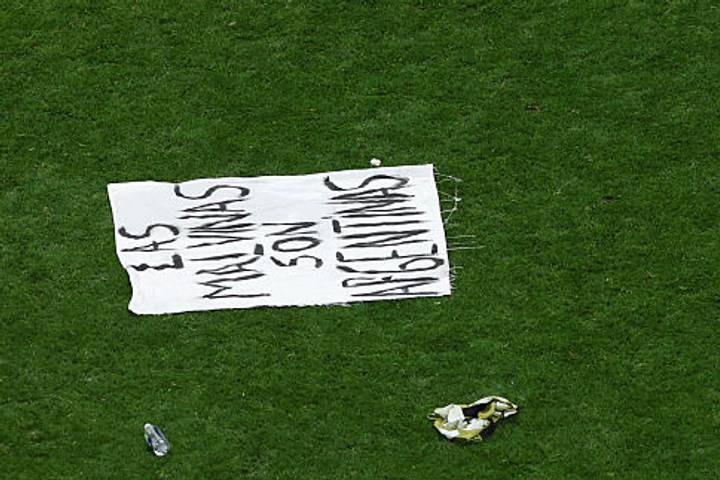
Should Argentina be found guilty of violating FIFA's regulations, two forms of punishment are possible: a financial fine or player suspensions.
In 2014, the AFA was fined 30,000 CHF ($37,000) after players displayed a banner bearing the same slogan prior to a 2–0 friendly victory over Slovenia. A comparable penalty could be issued once more. Nevertheless, there is precedent for FIFA imposing a harsher punishment directed at the players themselves.
AS points to the case of South Korean player Park Jong-woo, who received a two-match ban from FIFA after holding up a banner supporting the Korean claim over the Liancourt Rocks during the 2012 Olympic Games in London.
Could Any Players Miss the Final?
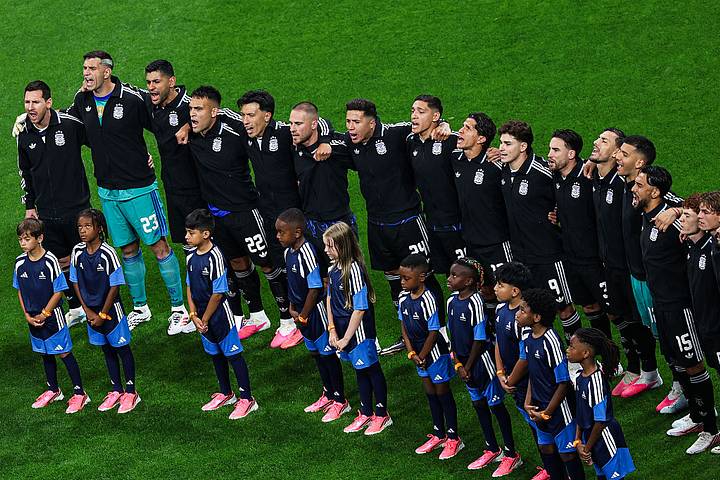
Importantly, Jong-woo's ban was the result of an extended investigation, with his two-match suspension only issued in December 2012—months after the incident took place during the bronze medal match at the Olympic Games.
There is virtually no possibility that FIFA could impose such swift punishments in this instance, even if it wished to. The governing body is instead more likely to tread carefully to avoid disrupting its marquee event.
Enable functional cookies to see this feature.
In summary, the likes of Lo Celso, Paredes and others will almost certainly be available for Sunday's final at MetLife Stadium.
With neither Argentina nor Spain receiving red cards during the semifinals, both teams are expected to have their full squads available for selection ahead of the match.