
 ไทย
ไทย English
 中國人
中國人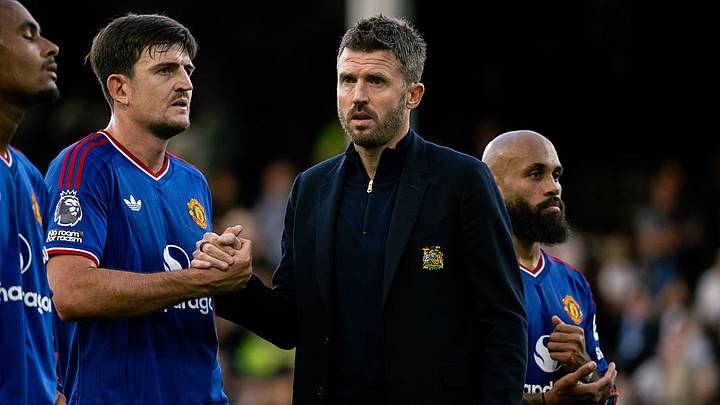
Manchester United salvaged a point with a late, heavily deflected Matheus Cunha equalizer in their Premier League away fixture against Fulham on Sunday.
Coming off a dismal collapse against Brighton & Hove Albion in the Carabao Cup, Michael Carrick's side fell behind at Craven Cottage via a 63rd-minute Lisandro Martínez own goal.
Having suffered defeat—albeit under contentious circumstances—to Manchester City the previous week, it appeared United were heading for back-to-back Premier League losses for the first time in over a year, dating back to the close of the 2024–25 campaign. However, Cunha's long-range effort in the 89th minute beat Bernd Leno after deflecting off center back David Affengruber.
Five points from five matches represents the joint-lowest return for a Manchester United side at this point in a Premier League season, equaling their 2014–15 tally.
With a three-week gap before their next fixture due to an extended international break, United will remain 12th in the table until they take on bottom-placed Tottenham Hotspur on Oct. 10.
The 'Worst' 15 Minutes From Man Utd in Nearly Half a Century
5 - With five points, this is Manchester United's joint-lowest tally after five games of a Premier League season, also picking up five in 2014-15.
Sluggish. pic.twitter.com/UZTBWRpGnm
Providing live commentary and analysis for Sky Sports, Gary Neville described the opening quarter-hour of the second half as the "worst" 15 minutes he has ever witnessed from any Manchester United team—having followed the club since the age of five back in 1980.
It was lethargic, uninspired, and ultimately allowed Fulham—who entered the match as the Premier League's weakest side—to take a thoroughly deserved lead.
Too many United players were guilty of low intensity and walking the pitch. Collectively, the Red Devils covered nearly 7 kilometers (4.3 miles) less ground than Fulham by the 73rd minute. Yet they were noticeably the stronger side in the closing 15 minutes. Leno made five saves in total, with three coming after Fulham had taken the lead. That late surge of energy was encouraging—so why wasn't it there from the outset? It was far too little, far too late.
Lammens Learns the Hard Way

United goalkeeper Senne Lammens produced four saves in the first half alone, most impressively denying Joshua King and Sander Berge within minutes of each other.
The Belgian was named Premier League Signing of the Season at the conclusion of his debut campaign, but a costly World Cup error that contributed to his nation's elimination—combined with public reservations about his long-term suitability expressed by Old Trafford icon Paul Scholes—has shaped a somewhat different narrative around Lammens heading into this season.
He will feel he could have handled the situation better when Fulham broke the deadlock, parrying Calvin Bassey's initial effort back into a dangerous zone. The ball then ricocheted off an unsuspecting Martínez, with Lammens attempting a foot save when diving would have been the wiser choice. He was perhaps overly concerned about being penalized for handling a back pass—though since Martínez's touch was unintentional, no infringement would have been called.
Shortly after, Lammens managed to parry a Kevin shot away from goal and out of harm's way. He cannot be blamed for the result and is credited with preventing 1.48 Fulham goals according to FotMob, even topping the player ratings across both squads. But the margins at this level are so fine that even minor imperfections can prove decisive.
Rashford Needs to Offer More

Marcus Rashford's reintegration following his return from 18 months on loan at Aston Villa and Barcelona has largely been viewed as a positive development. The England international addressed an obvious gap on the left flank and has demonstrated his quality at the top level for a decade.
Over 77 minutes in this fixture, Rashford registered both the most touches in the opposition box (10) and the most shots (6). He passed accurately (89% completion) and created four chances. On paper, those numbers look encouraging. Yet his expected goals (xG) at the time of his substitution—replaced by Joshua Zirkzee—stood at just 0.34, with expected assists (xA) at 0.14.
He has drawn praise in recent weeks for appearing sharp and visibly committed. But effort alone is not sufficient. Rashford is now six appearances into the 2026–27 campaign across all competitions, with 435 minutes on the pitch, and has yet to register either a goal or an assist.
While it is entirely possible to contribute meaningfully without scoring or setting up goals, those statistics ultimately define every forward at this level. If you're not finding the net or creating goals, the question has to be asked: what tangible impact are you making?
Man Utd Debut Blue Kit for No Obvious Reason

Setting aside the football itself, United unveiled their all-blue away strip in a competitive match on Sunday, having previously only worn it during preseason. That in itself is unremarkable, but what raises an eyebrow is the choice of this particular fixture.
Away kits exist in football to avoid color clashes, which is why a team's home jersey is typically worn in both home and away settings. However, it has become increasingly common over the past decade or so for clubs to switch kits regardless of whether a clash actually exists.
There was no color conflict here, with Fulham's white shirts, black shorts and white socks clearly contrasting with United's traditional red shirts, white shorts and black socks. Yet the blue kit was still selected, with the club's official website noting beforehand that this was likely the first occasion United had visited Craven Cottage without wearing red.
Even as the practice has become a fixture of modern elite football, no definitive explanation has ever emerged for these seemingly arbitrary kit changes. Some speculate it stems from a contractual obligation or quota requirement, but an 'experienced sports lawyer' cited by U.K. magazine When Saturday Comes stated in 2018 that "this is unlikely," suggesting instead that since "clubs are usually incentivized on the basis of kit sales, it'll be the club itself that elects to push the different kits."